





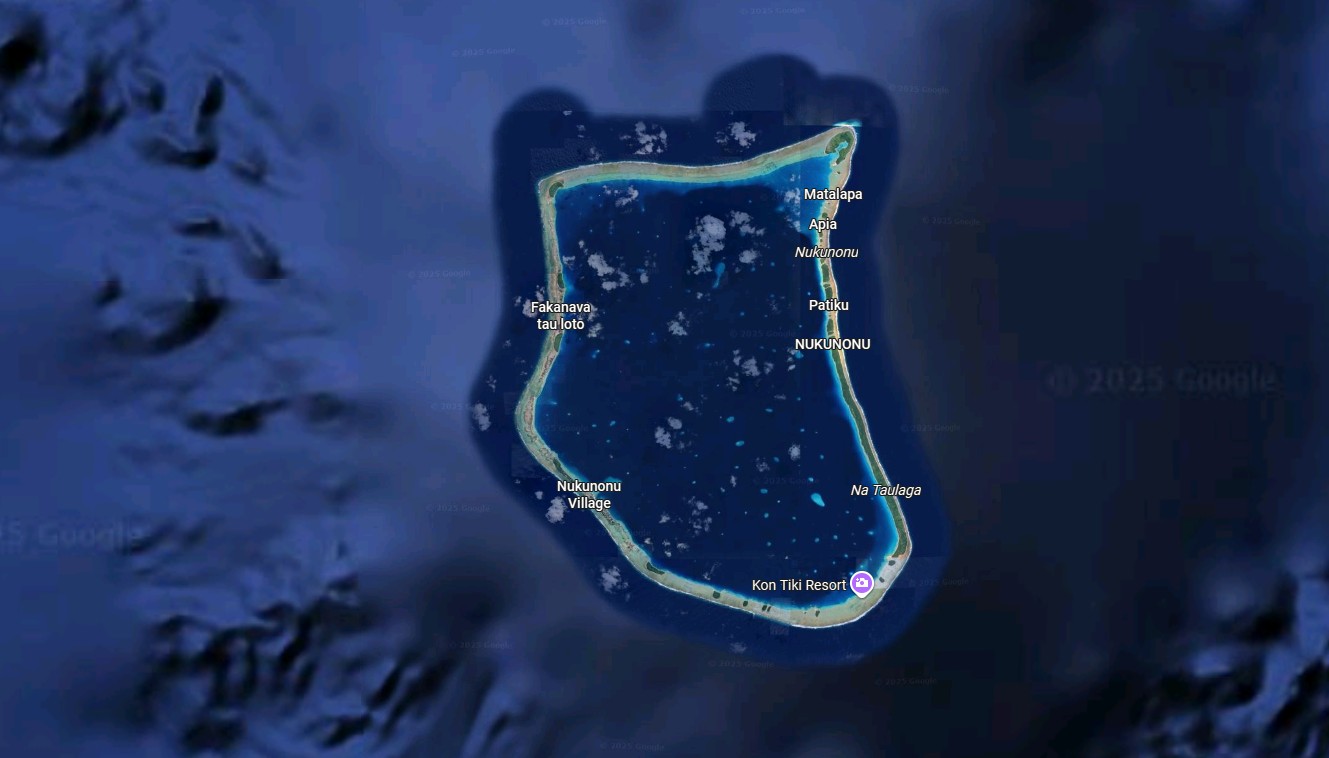
A recent post at the website Energies Media, titled “It became the first nation 100% powered by solar energy — Now climate change threatens its survival this very century,” claims that the Pacific island territory of Tokelau went 100 percent solar and is threatened by rising seas due to climate change. This is false on multiple counts. Tokelau neither runs 100 percent on solar electricity, nor is it under threat from rising seas.
Energies Media claims “Tokelau, located in the South Pacific, became the first worldwide to achieve self-sufficiency with solar energy,” and the island’s “very existence is being threatened” by rising seas. Energies Media goes on to claim that solving Tokelau’s “submergence” problem is “becoming increasingly impossible by the day.”
Tokelau may have been the first to achieve 100 percent solar power electricity for a short period in 2012, but that isn’t saying much. Since then, the island nation has not maintained this status as their small energy demand grew, requiring other sources of electric power. Tokelau only has 2,664 people on their tiny island nation, and currently runs on about 90 percent solar while the rest is covered by diesel (including coconut oil biodiesel) backup. The article conveniently leaves this out, and fails to mention that a 2020 study found “the actual supply [of solar] is now about 90% with supply difficulties under cloudy conditions or with battery failures.” Some sources report that the percent of solar has declined even more since then, to as low as 75 percent by 2020.
Tokelau’s economy relies nearly entirely on subsistence agriculture and fishing, having an extremely small energy demand compared to other nations, so small that Our World In Data has hardly any data beyond reporting that Tokelau’s installed solar capacity is around 0.001 GW. For comparison, the state of Rhode Island has less than 0.872 GW installed solar capacity. Granted, the population of Rhode Island is more than one million people, with major industry and a much higher standard of living.
But problems with the Energies Media post don’t end at disagreement over the definition of “100 percent.” Tokelau is also not sinking under the waves. It is actually the opposite, according to a 2021 land survey study “Global-scale changes in the area of atoll islands during the 21st century,” by Holdaway et al. The study examined the landmass area of atoll islands in the Pacific and Indian Oceans, and reported that no major reduction has occurred, even as average sea level has modestly, slowly, risen over the past decades. It gets worse for Energies Media’s claim, because the study found “Tokelau and Tuvalu, both small landmasses (9.65 km2 and 25.14 km²respectively), both increased by ∼7%.”
This is because these islands, as coral atolls, grow as the seas rise as corals reach towards the sunlight, and storms and waves deposit sand on the coastlines.
The problem of Tokelau’s “submergence” cannot be increasingly impossible to solve when it is not submerging in the first place.
As an aside, it seems likely this article was written using AI, based on its structure and vagueness but also because it contained no links to relevant sources, and failed to note that the most recent data on Pacific atoll type islands, including Tokelau, are not losing land but rather gaining it. The author, “Anke,” suspiciously has no biography whatsoever.
Energies Media seems to have relied on a lot of very outdated information to make their fearmongering claims about Tokelau. If the media outlet was really interested in the facts rather than pushing climate alarmism, it would know the status of Pacific atolls and the discrepancy between the claims of 100 percent solar self-sufficiency and the reality of 75 to 90 percent, with the islands inhabitants accepting intermittency and limited electric power availability on demand and at night.






Hooray for independent internet news aggregators like this site. Irony is I live in Australia and discovered this article on a similar German site having translated your excellent article. Which doesn’t get a mention in the local media being my point. Twenty years ago I was starting to imagine me sitting one night on my roof as I live between a river and the ocean on a land tongue. Hasn’t happened and after reading Patrick Moore ex founder of Greanpeace turn into green bilge feel much better thanking you too.