


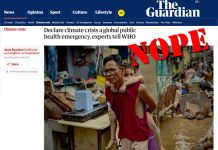

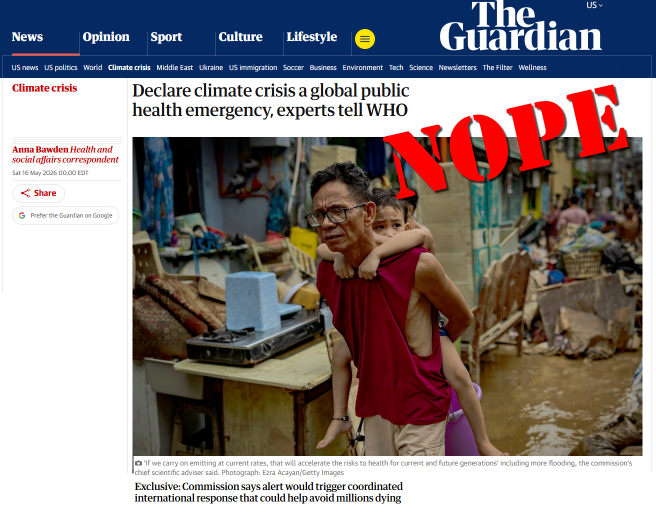
The Guardian published an article promoting a call by some scientists for the World Health Organization (WHO) to “Declare climate crisis a global public health emergency.” The fact is there is no climate induced public health emergency meriting such action by the WHO. Deaths due to climate factors and temperatures have declined markedly during the period of recent modest warming. Deaths from vector-borne diseases are a mixed bag, with some declining and others increasing, but its unclear whether climate change has played a role in any increase. By contrast, a better response to insect-borne diseases is direct action, using technologies to either destroy the insects carrying the diseases or to prevent people from being infected, and expanding the use of medicines developed to minimize the symptoms of and harms caused by the diseases, rather than trying to prevent the spread indirectly by reducing fossil fuel use.
Describing the call for WHO action, The Guardian writes:
The climate crisis should be declared a global public health emergency by the World Health Organization, or millions more people will die unnecessarily, leading international experts have said.
The independent pan-European commission on climate and health (ECCH), which was convened by the WHO, concluded the climate crisis was such a worldwide threat to health that the WHO should declare it “a public health emergency of international concern”
Commission says alert would trigger coordinated international response that could help avoid millions dying.
With the hits to the WHO’s reputation in the aftermath of the COVID-19 debacle, where the WHO denied the virus’ Chinese origins under pressure from the Chinese Communist party, it’s not clear how seriously the world would respond to a call from the WHO to treat climate change as a health emergency. Especially since: a) the United States, its biggest contributor, pulled out of the WHO as a result of its COVID-19 era actions as well as other attempts to enter into the public policy field, like treating gun violence as a public health threat and calling for firearms restrictions; and b) most surveys show a majority of people don’t believe climate change will affect them, and an even larger majority say they are unwilling to pay much at all to fight climate change.
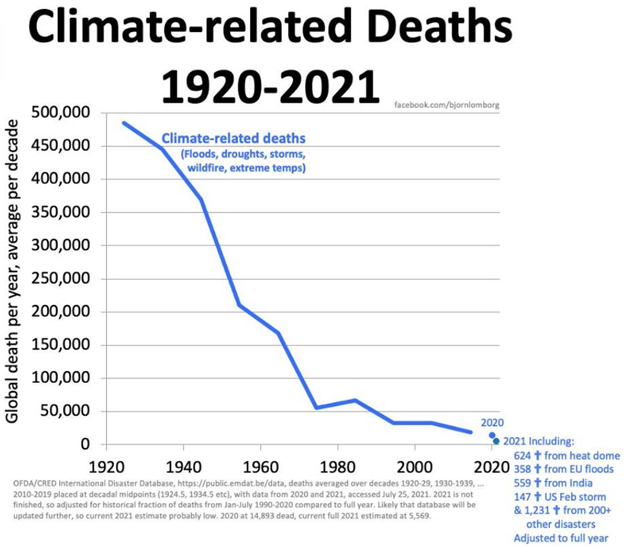
The WHO would be following the science if it refused to accede to The Guardians’ and the ECCH’s call to declare climate change a public health emergency. It is not. Dispositive data clearly show both temperature-related deaths and deaths due to extreme weather events have declined dramatically over the past century, even as the global average temperature — a made up metric based on limited cherry-picked data with no meaningful reference — has slightly risen. (See the graph below detailing the decline in weather related deaths).
That leaves only the claim that climate change is causing an increase in vector-borne diseases, which is very much open to debate. As detailed in Chapter Four of Climate Change Reconsidered II: Fossil Fuels, the vast body of scientific literature refutes climate activists’ claim that climate change is likely to exacerbate the spread of mosquito-borne diseases. Sufficiently high temperatures are a necessary but not a sufficient factor for disease carrying mosquitoes to flourish. Climate Realism has refuted previous claims that climate change was likely to see an upsurge in vector-borne diseases on dozens of occasions, explaining why that is unlikely to be the case, here, here, and here, for example
Malaria, by far the most widespread and prevalent vector-borne disease, the one that also claims the most lives annually, has declined dramatically during the period of modern warming due to direct interventions, primarily the use of pesticides to kill the host mosquitos and medicines to prevent infection. The global death toll for malaria has been cut in half since 2000. It has also not spread to new regions where it had not been previously known historically despite slightly warmer temperatures.
For other insect-borne diseases the trends are a mixed bag, waxing and waning annually except for Dengue fever which has seen a dramatic rise in reported cases. The question is, is this due to solely or primarily to climate change or other factors, and the evidence suggests, that climate change, at best, is playing a small role. Dengue is endemic to countries astride or near the equator, where temperatures have always been and remain suitable for the mosquito species that carries the disease to thrive. While temperatures have increased in the northern latitudes, they have not changed much along the equator, thus a dramatic temperature increase is not making habitat where the carrier mosquitos already thrive more suitable for them. Nor have rainfall patterns changed that much in tropical countries along the equator except where deforestation has altered humidity and cloud formation.
Part of the increase is due to improved reporting and tracking. Many of the host countries haven’t had, and in some cases still have inadequate, strong detection and reporting mechanisms. As a result, Dengue fever cases have likely historically been undercounted, with improved surveillance and reporting now counting cases that would have been missed previously.
In addition, population growth, especially in urban areas, has contributed to the expansion of Dengue. Dense, poorly planned cities create ideal mosquito habitat, such as standing water, crowding, and high human density makes the spread easier – more people living close together as food sources for the mosquitos. Dengue can also spread from mother to child during pregnancy, and through poor blood screening, both problems in developing countries with limited public health screening and high population growth. Finally, Dengue fever has been diagnosed in countries thousands of miles from where it is endemic. This is due to increased mobility, trade, and travel, with tourists being infected during travel and bringing the disease back home and companies bringing the mosquitoes in on goods, like plants, imported into the country. In short, a slight increase in temperatures may speed up the breeding cycle of mosquitoes that carry Dengue fever, but the change is not large enough to account for most of the expansion of the disease.
The quickest, surest way to dramatically reduce the incidences of Dengue fever along with a host of other vector-borne diseases regardless of climate change is through direct interventions, not reducing fossil fuel use in the hope of modestly reducing global average temperatures 50 or 100 years from now. Those might include public health campaigns encouraging populations to drain reservoirs or pools of stagnant water and prevent the collection of stagnant water going forward, improved medical testing, and the widespread access to and use of effective pesticides —often fossil fuel based or derived — in countries and regions lacking such access or where global authorities have discouraged their use. Other options could include speeding up the development and deployment of genetically modified mosquitoes which, in test plots, have suppressed or prevented, mosquito reproduction.
If the WHO wanted to have an impact, it could divert funding from non-public health programs, like any having to do with climate change, or firearms, gender transitioning, or other social and political issues, and devote more resources to the development of vaccines to improve the resistance to or even prevent the spread of various vector-borne diseases and/or to effectively treat such diseases once contracted.
In the end, contrary to the ECCH’s claims there is no legitimate reason for the WHO to declare climate change a public health emergency. Deaths related to temperatures, disease, and extreme weather have declined dramatically during the recent period of modest warming. For ECCH and The Guardian to pretend otherwise is just bad science and bad journalism in pursuit of contested pollical ends, specifically the end of fossil fuel use. Were the WHO to follow ECCH’s and The Guardian’s recommendations, it might only serve to further damage its already beleaguered reputation.