





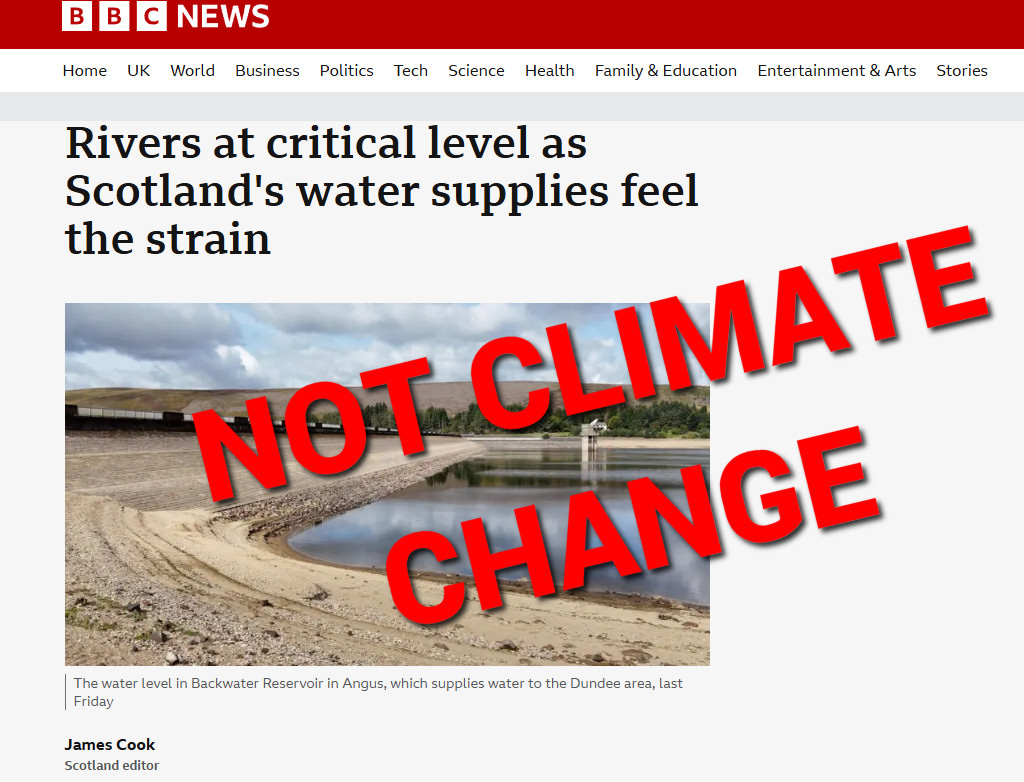
The BBC published a story by Scotland editor, James Cook, blaming climate change for low catchment, river, and reservoir levels across the country. A detailed look at actual data shows this is false. Scotland, though generally rainy and wet, has experienced droughts and low water levels before, during periods when global average temperatures and carbon dioxide concentrations were lower.
“Scotland is known for its rainfall, famed as a lush, green, soggy nation. Not this year,” opens the BBC’s story, titled “Rivers at critical level as Scotland’s water supplies feel the strain.” Cook then leads readers to believe that climate change has put the country’s water supply at risk, writing, “[c]limate scientists call the swings between these extremes weather whiplash and they affect us all.” As proof, Cook then cites Dr. Rebecca Wade, a senior lecturer in environmental science at Abertay University in Dundee, who says:
“Our climate is changing which means that sometimes we have a lot less water than we’re used to having,” she explains.
“Also, when we do get rainfall, it comes in a different pattern.”
“So, we might get a very intense short storm, and that could even cause localised flooding, but at the same time, it doesn’t resolve the drought situations because it’s not recharging the groundwater. It’s not filling up the reservoirs.”
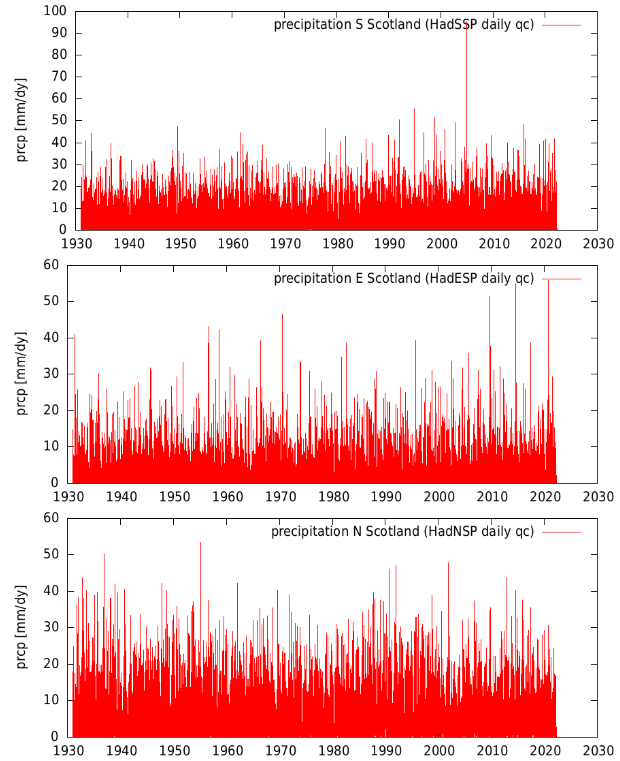
Wade’s statements are thoroughly refuted by easily available meteorological data which shows no increase in short, intense rainfall events.
Met Office daily records for Scotland’s regions, plotted over nearly a century, display a consistent pattern with no surge in extreme rainfall days. The supposed “weather whiplash” of heavy storms followed by dry spells is falsified by the observational record, as seen below in Figure 1.
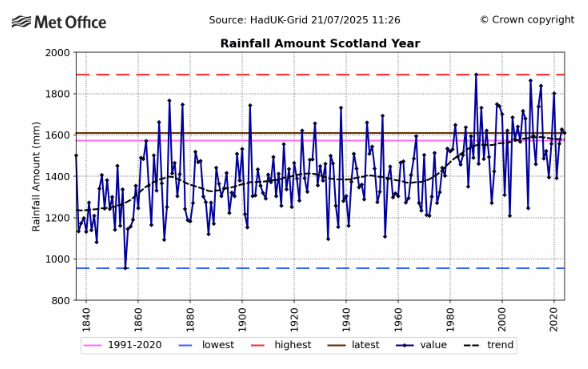
Paul Homewood, in a post at “Not a lot of People Know That,” also examined Met Office rainfall records and found no long-term drying trend in Scotland. In fact, rainfall today is slightly higher on average than it was in the 19th century. The annual chart he displays going back to 1840 shows ups and downs but no sign of an emerging climate driven drought, as seen below in Figure 2.
Cook failed to cite any of this data, rather his article leans heavily on anecdotes, describing farms carting water to cattle, towns supplied by a water truck-tanker, and reservoirs less than half full. Such stories are colorful, but they are not evidence of a new climate regime. Scotland has always experienced dry years, particularly in the east half of the country where rainfall is naturally lower than the west.
Further, a Met Office report states that there is very low confidence in trends for sub-daily extreme rainfall events (those lasting less than a day) because of limited observations and studies. Accordingly, there is no conclusive evidence indicating such extremes are increasing in Scotland—or the UK more broadly. In addition, a detailed report from ClimateXChange similarly concludes that there is no clear trend in summer rainfall over the last century. While heavy winter rainfall and days of heavy rain in winter have increased since 1960, the overall long-term trend across seasons remains ambiguous.
What matters is whether those episodes are becoming more frequent or more severe. The long-term observational evidence says they are not. In short, a single season in a single year’s low rainfall in a can’t be considered evidence of climate change, only a multi-decade trend could indicate such a shift, and for Scotland there is no such long-term trend. By elevating short-term weather events to the level of climate change, the BBC grossly misleads its readers into mistaking natural variability for a climate crisis.
What we are dealing with in 2025 is simply a dry spring, the driest since 1964, but one that was followed by above-average rainfall in June and July.
Scotland’s water system does have real man-made problems, but climate change is not among them. The Scotland Herald reports that per capita consumption in Scotland is far higher than in England and Wales, averaging 178 liters a day compared with 140 liters. Scottish water system leakage rates also a problem , its system loses more than 80 liters per person per day through crack pipes and leaking joints. Also, most Scottish households are unmetered, so there is little incentive to conserve. To make matters worse despite Scotland’s population growing by nearly 9 percent since turn of the century, no new reservoir has been built in Scotland in thirty years. These are glaring issues of policy and infrastructure, but they receive only passing mention in the BBC report. Instead, the focus is shifted toward climate change, a convenient culprit that allows public bodies to deflect responsibility.
It is worth recalling that Scotland is one of the wettest countries in Europe. Parts of the western Highlands receive over 4,000mm of rain each year, while even the drier eastern regions average 700mm. In such a setting, to speak of chronic drought is absurd. Periodic dry spells are normal, and reservoirs will always fluctuate. If shortages arise, they are the result of water mismanagement, not a changing climate.
The Met Office rainfall records show Scotland’s rainfall to be steady, if not slightly increasing, with no evidence of intensifying drought. By ignoring that reality, the BBC substitutes narrative for fact. The BBC owes its readers honest reporting grounded in real data. And the truth is a story of natural weather variability colliding with human water infrastructure neglect, not one of catastrophic climate change. Until the BBC is prepared to report that truth, its coverage will continue to be a disservice to its viewers, listeners, and readers.





This article is spot on! The BBCs climate scare narrative in Scotland is pure fiction. Rainfall records show no long-term drying trend, and the real issue is wasteful water use, not fake climate crisis. Glad someones calling out this alarmist nonsense.