







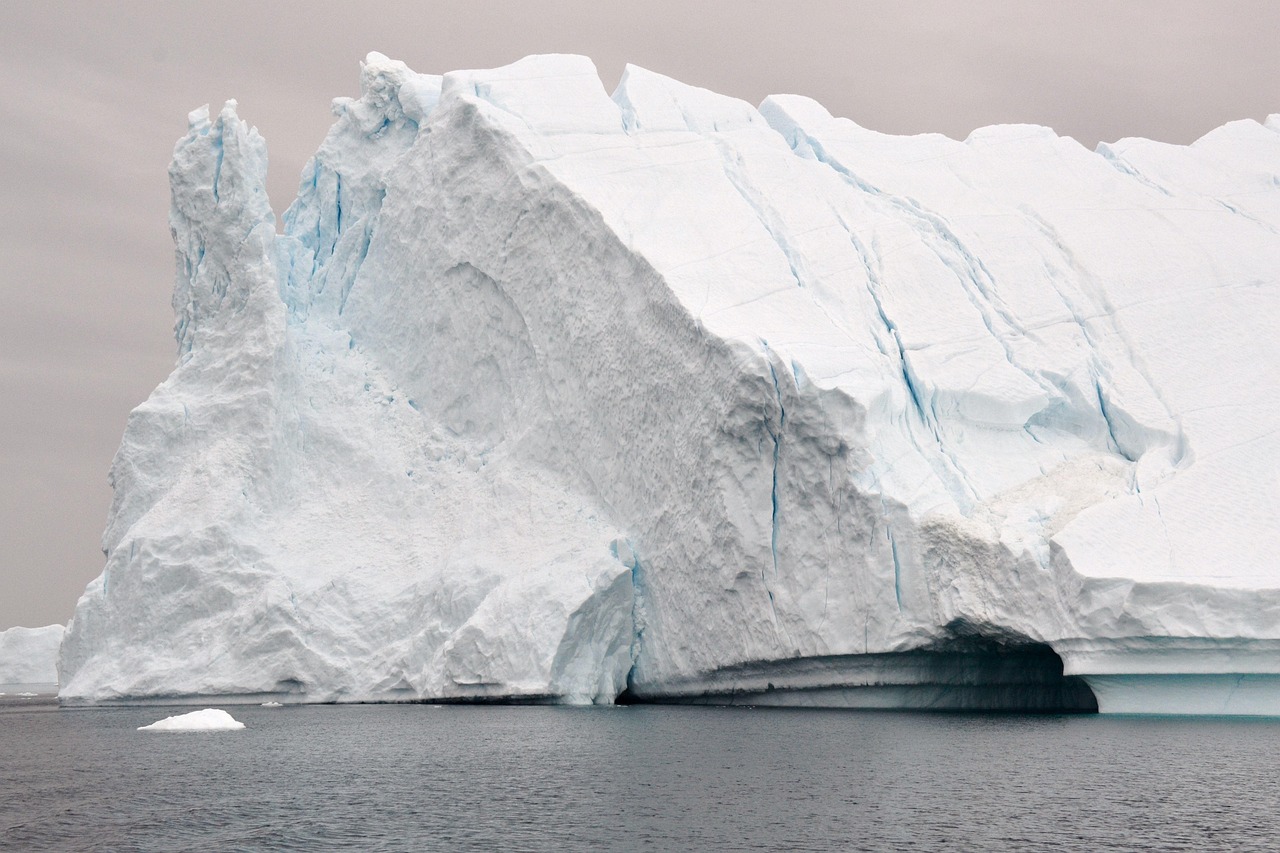
The New York Post (NYP) covered a recent study that claims the “Gulf Stream” could soon collapse due to human caused climate change. Scientifically, the Atlantic Meridional Overturning Circulation (AMOC) has slowed and sped up on its own due to physical factors that humans have no control over, but it has never before caused a major ice age, although its slowing has cooled regions on the order of years and decades. As importantly, the study cited by the NYP is disputed by other studies published in peer-reviewed journals over the past year and decade that come to the opposite conclusion, that the AMOC has sped up or has neither increased nor decreased in strength or speed during the period of recent warming.
The NYP story, “Climate scientists claim Gulf Stream could be near collapse — predicting a new ice age,” is couched in uncertainty, as is appropriate to the topic. Climate scientists claiming something doesn’t make it true, especially when other scientists claim the Gulf Stream isn’t changing much or is speeding up. At least the headline read “could” be near collapse. Could is very vague. A lot of things, both disastrous and beneficial for life on Earth, could happen in the days, weeks, years, and decades ahead, but that doesn’t mean they are likely and that society should spend precious time and resources worrying about them. Studying those that are likely, yes; completely transforming our lives and economic systems on the off chance that it might modestly impact something as vast and poorly understood as the Gulf Stream, no.
Parsing the claims made in the NYP and the study, one finds many problematic, disputed, and some easily falsified claims.
Per the new findings, the at-risk current in question is the Atlantic Meridional Overturning Circulation, or AMOC, a “conveyor belt of the ocean” that funnels warm water toward the ocean surface from the tropics to the Northern Hemisphere.
This current, which includes the Gulf Stream that runs from the Gulf of Mexico to the US East Coast and across the Atlantic to Europe, helps maintain the mild climate of Europe, the UK and the US East Coast.
The study stated that the source of this marine temperature regulator, the Greenland Ice sheet, is being thawed amid warming temperatures, causing meltwater runoff to leach into the North Atlantic — leading to stagnation.
This has resulted in a “distinctive temperature fingerprint” located some 3,280 to 6,560 feet below the ocean’s surface, according to reporting by the Daily Mail.
“Here we identify a distinctive temperature fingerprint in the equatorial Atlantic that signals the Atlantic Meridional Overturning Circulation change,” the authors wrote. “The robust physical mechanism and reliable detection make [this fingerprint] a valuable metric for AMOC monitoring in a warming climate.”
The presence of the marine hot pocket appears to suggest that the current slowdown has been occurring for decades and could foment a total decline before the end of the century, per the study.
First, we have only been able to study the AMOC for a few decades, and there are no good proxies for its historic behavior before we began direct, somewhat precise observations. This means that what these scientists have measured may or may not be unusual across years, decades, centuries, or millennia. The researchers involved aren’t measuring the AMOC directly. Rather, they discovered a “hot pocket” deep beneath the ocean that they consider to be a proxy for a “distinctive temperature fingerprint” or “valuable metric” for changes in the AMOC. But, of course, the discovery of this hot pocket or metric is even more recent than the study of the AMOC itself. The researchers can’t know how long it has been around, whether it has grown or shrunk from past extent, or truly what its existence indicates.
A better indicator of the AMOC would be to measure the speed of the current directly, both along its entire track, and in its distinct segments. Other scientists have done this in recent years and months and, as discussed at Climate Realism, have concluded the AMOC is either stable or speeding up.
Studies published in the prominent peer-reviewed journal Science in 2020 and 2022 both report that the AMOC has sped up in recent decades, rather than slowed down. Two peer-reviewed studies in the journal Nature, one in February 2025 and one in January 2025, found that the AMOC has remained stable for at least 60 years, displaying no significant slowing trend. The researchers who undertook those studies found no credible evidence to suggest that a collapse is imminent or even likely in the foreseeable future. Commenting on the climate models that have forecast a collapse of the AMOC, the scientists carrying out the research concluded that climate models are flawed and overstate the risks. Since these studies didn’t play into the narrative that humans are causing dangerous climate change that was disrupting the Gulf Stream and the AMOC, they received minimal media coverage.
What is true of taking climate model simulations as accurate representations of the AMOC is equally true of treating a recently discovered hot blob in the ocean as proxy for a waning AMOC when direct measurement of the phenomenon is available. Neither is justified scientifically.
Second, both the claimed cause of the AMOC decline and the predicted impacts on sea levels are simply wrong. As discussed at Climate at a Glance: Greenland Ice Melt, while many headlines have blared in recent years that Greenland is melting unusually rapidly, the melting and thawing are normal for Greenland each year, and most of the ice that melted in Greenland never reached the sea. It just refroze. (See the figure, below for Greenland’s relative ice loss).
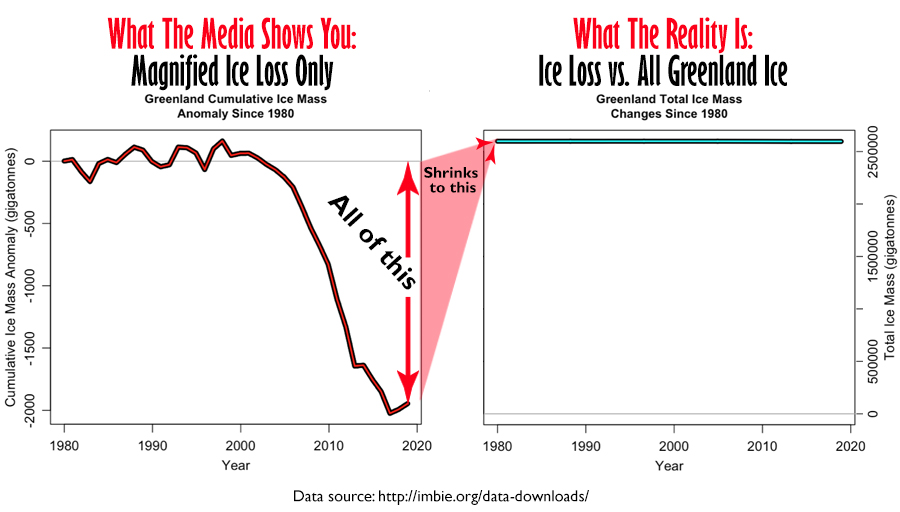
So, contrary to the scientists claims, Greenland’s ice sheet is not “being thawed.” If Greenland isn’t losing massive amounts of ice, colder water flowing from Greenland can’t be disrupting the AMOC’s ability to transport warm and cold water around the Atlantic from North to South and back.
“A key Atlantic current could be pushed to the brink of collapse within decades, supposedly ushering in a new ice age and dramatically raising sea levels, climate scientists have claimed in a controversial new study published in the journal Communications Earth & Environment,” writes the NYP.
Labeling this study “controversial” as opposed to nonsense is kind on the NYP’s part, since the claim that the AMOC’s collapse would lead to both the next ice age and rising seas is nonsensical. During ice ages, seas fall dramatically as the water stored in the oceans is what forms the glaciers. Seas rise during interglacial periods as the ice sheets retreat and return water to the seas. You can’t have both rising seas and glacial expansion across the land – where does the water for the glacier growth come from?
The final and ultimately dispositive nail in the coffin for the claim that a dramatically slowed or stalled AMOC would lead to the next ice age is our historical, scientific understanding of the causes of past ice ages. The causes of what scientists refer to as ice ages, periods of a hundred thousand years or more where glaciers grow from the arctic to cover vast swaths of the Northern Hemisphere, are multiple and complex, of which AMOC currently may play, at best, a small part.
There is some evidence that a combination of a slowed AMOC coinciding with periods of reduced solar activity have been responsible for mini-ice ages in the past, lowering temperatures modestly with mountain glaciers expanding some, and temperatures dropping disrupting crop production. However, these periods have occurred without any contribution from humanity and are not what the recent study and the NYP’s reporting of it bring to mind. Rather, what the scientists are implying is that a stagnant AMOC by itself, will cause a true ice age with, for example, glaciers reclaiming Canada and parts of the United States and Europe, leaving a vast swath of humanity shivering, with what remains of modern civilization living hand to mouth – a “Day After Tomorrow” scenario.
But true ice ages aren’t caused by collapsed AMOC or reduced sun spots. Rather, these large scale geologic phenomena are a result of Milankovitch cycles, during which: the
Earth’s Eccentricity, that is its orbit, changes from nearly circular to more elliptical over cycles of about 100,000 to 400,000 years; the tilt of Earth’s axis, its Obliquity, changes over a cycle of about 41,000 years; and the wobble of Earth’s axis, or its Precession, changes the orientation of the tilt, affecting the distribution of sunlight received at different times of the year over a cycle of about 26,000 years. These are the main drivers of ice ages, which also occur, it is worth noting, when carbon dioxide levels are in decline and much lower than now.
To conclude, while another ice age will likely occur in the future, a slowing AMOC physically can’t be the cause. Also there is no evidence an ice age is pending in the near future. Perhaps, going forward, the New York Post and other news outlets should ignore studies that make claims about pending ice ages from causes that are physically impossible, being refuted by physics and real world data.