








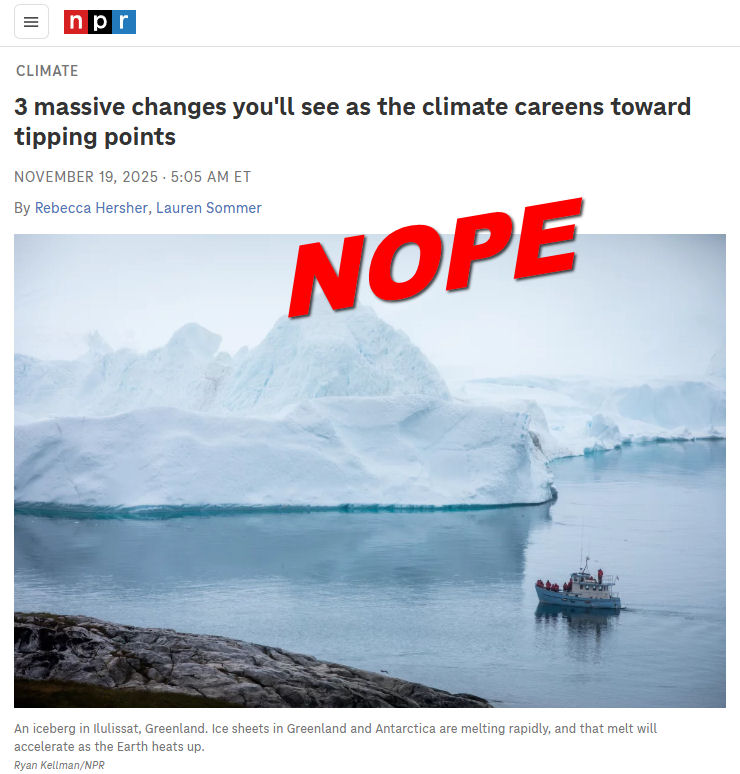
National Public Radio (NPR) recently posted an article titled, “3 massive changes you’ll see as the climate careens toward tipping points,” by Rebecca Hersher and Lauren Sommer, which claims that coral reefs, the Greenland and West Antarctic ice sheets, and Arctic permafrost are approaching dangerous, near-irreversible climate “tipping points.” NPR’s claims are false. There is no evidence that coral reefs, the ice sheets in Greenland and West Antarctica, or Arctic permafrost are caught in a loop of inevitable decline due to human-caused greenhouse gas emissions. Data show that other factors are at play, and that the so-called tipping points are far from certain.
Let’s start with Greenland. As Climate at a Glance: Greenland Ice Melt discusses, Greenland contains roughly three million gigatons of ice – a value so large it is nearly impossible to comprehend. Even during the highly publicized melt years of the past decade, annual losses represent less than 0.01 percent of the total ice sheet. (See the figure, below). Further, as documented by NASA’s GRACE satellite gravity analysis, the observed mass losses from all sources contribute well under a millimeter per year to global sea level. The minimal recorded loss of ice mass is in large part due to the fact that ice that has melted refroze before ever reaching the sea.
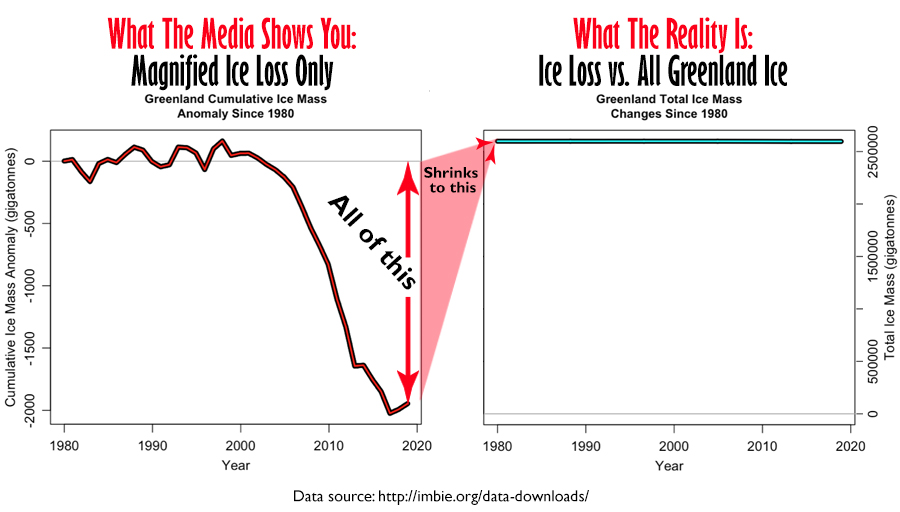
NPR omits this important context entirely and also ignores major research showing that a substantial portion of recent Greenland surface melt is driven by darkened, low-albedo “dirty ice,” caused by soot, dust, and microbial darkening, not simply by rising air temperature.
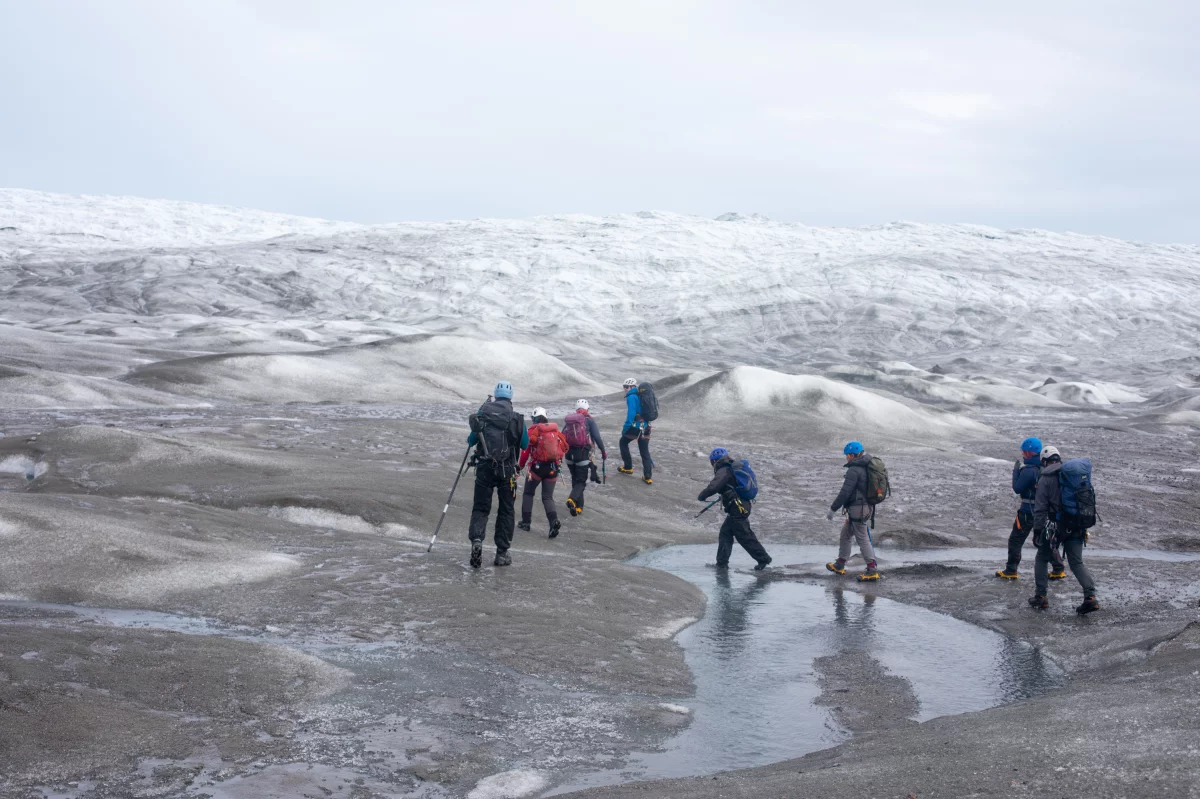
Ironically, the NPR article itself provides a photo of “dirty ice” with apparently oblivious scientific researchers trekking across it, seen below.
The article’s coral-reef tipping-point narrative is similarly false. Climate at a Glance’s “Coral Reefs” and “The Great Barrier Reef” show that corals have repeatedly demonstrated resilience over millions of years, surviving periods significantly warmer than today. Bleaching is a stress response, not a death sentence, and long-term monitoring by the Australian Institute of Marine Science has shown record-high coral cover following recent bleaching episodes. Multiple Climate Realism analyses highlight misreported coral-collapse claims, documenting how media narratives routinely ignore recovery. In addition, where coral has struggled in recent years, NPR ignores the role of local stressors, such as, pollution, sediment runoff, destructive fishing, and coastal development, which have contributed to true coral death on occasion, far outweighing small changes in ocean temperature as a factor.
NPR’s third “tipping point,” permafrost, relies on speculative model projections rather than observations. Although permafrost thaw is happening in some regions, methane trends do not match the runaway-loop scenario described. Peer-reviewed research summarized by Climate Realism in “Purdue Study Destroys the ‘Permafrost Methane Bomb’ Myth,” shows that thawed permafrost releases significantly less methane than early models predicted, with microbial oxidation, hydrology, and soil conditions limiting net emissions. Additional critique of runaway-feedback claims appears in Climate Realism’s review of flawed permafrost-collapse modeling, where even climate-alarmism proponents describe such models as unrealistic. NPR mentions none of this literature.
NPR’s “tipping point” claims are not new in either tenor or specifics; rather, they repeat a predictable pattern: dramatic scenarios derived from models are presented as near-term certainties, while actual measurements that undercut those scenarios are downplayed or omitted entirely. For Greenland, NPR omits that annual melt is microscopic relative to the ice sheet’s mass or that surface darkening, not temperature alone, drives melting. For corals, NPR ignores the empirical record of rapid recovery and the documented role of local human impacts. For permafrost, the article conflates regional thaw and infrastructure damage with large-scale climate feedbacks that measurements simply do not support.
NPR also avoids critical scientific context: natural variability, multi-decadal oscillations, and regional environmental factors. The tipping-point narrative also sidesteps the fact that short-term excursions above the much feared global temperature threshold of 1.5°C in recent years did not produce the predicted avalanche of catastrophic extremes. In point of fact, science has revealed no known tipping points. They remain theoretical speculations based on flawed climate model assumptions about unverified feedback loops within the global ecosystem.
NPR listeners and readers deserve the truth, which can only be discovered when the full context of each alarmist claim is presented. Instead, shamefully, Hersher and Sommer betray the ideal of journalistic pursuit of the truth, and instead embrace advocacy, providing a simplified and scientifically unjustified trilogy of “tipping points,” tailored to motivate or justify policy actions at the COP30 conference. Equally shamefully, NPR’s editors and fact checkers let their reporters get away with this flagrant activism cloaked as objective reporting. That is not science communication, it’s climate doom theater.