




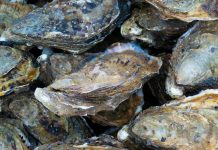





An article in Al Jazeera by Frankie Adkins, who covers climate and social justice issues, claims that climate change is harming Fiji’s oyster (both pearl and meat) industry. This is flat-out false. As is true for oyster production globally, Fiji’s pearl oyster and its nascent meat oyster industry have both experienced substantial growth in recent years. Multiple factors have harmed oyster production on a localized basis on occasion, but they have nothing to do with climate change.
In her Al Jazeera article, “Oyster farmers battle the climate crisis in Fiji’s troubled seas,” Adkins references the anecdotal experience of a couple traditional oyster harvesters who expressed their belief that the weather has gotten worse, damaging oyster beds and making fishing more difficult. Women paddling out on traditional bamboo rafts are the core of Fiji’s aquaculture industry, both for pearl producing oysters and black-lipped and rock oysters produced for meat. Adkins quotes one of those women, Jelly Ravea, who said:
“Every day, we should be able to eat something from the sea,” says Ravea, who wears a deep blue sulu, a traditional wrap, around her waist. “But times are hard, the shells are sometimes dead, and the oil from yachts spreads over the sea and kills the fish.”
Ravea, who has fished these waters for more than five decades, has long feared that the decline in fish goes beyond the ebb and flow of natural weather patterns. She blames climate change and poachers.
The climate connection is the impact of tropical cyclones, particularly a severe cyclone that struck in 2016, about which Adkins writes:
Warnings about extreme weather events are raising fears that fishing stocks will decline further. In March 2025, for example, a climate study predicted that tropical cyclones and extreme floods would increase in severity in Fiji, posing even more risks to coastal and marine livelihoods.
The country has only just recovered from 2016’s Cyclone Winston. The 26-day storm was the strongest on record in the Southern Hemisphere, costing an estimated 1.99 billion Fijian dollars ($875m) in damage. The cyclone affected more than half of Fiji’s population, killing 44 people and causing widespread damage and destruction to villages and farmland, particularly on the north coast of the main island, but also on the smaller islands.
“Cyclone Winston caused extensive damage to coral reefs, mangroves, and seagrass beds — critical habitats that sustain subsistence and small-scale commercial fisheries,” says Rosi Batibasaga, a WCS fisheries officer.
Coastal villages such as Vatulele were hit hard, she said: “They faced reduced fish availability, destroyed boats and fishing gear, and sharp declines in household income and food security.”
Fijians’ dependence on the sea is clear, and it is true that with widespread poverty, a single event, whether pollution, cyclone, or an ongoing problem with illegal fishing by fleets from other nations, can threaten lives and livelihoods. However, general data show that in Fiji and globally, oyster production is increasing and not being hampered by climate change. A single cyclone, nine years ago, no matter how severe, is not an indication of long-term, sustained, climate change.
Concerning oyster production, with the growth of aquaculture, including in Fiji, oyster production and sales have seen fairly regular growth in recent years. The oyster market outlook predicts continued growth: reports from Data Intelo and Stellar Market Research project annual growth of 3.49 percent in the oyster market from 2025 through 2032. Oyster production was growing before the pandemic, and after pandemic fear waned it began growing again. Data Intelo notes “global oyster farming market size was USD 8 Billion in 2023 and is likely to reach USD 10.7 Billion by 2032.” So, no climate change induced decline in oyster production globally.
What’s true for oyster production in general is equally true of oyster production in Fiji, where, over the past couple of decades, commercial oyster farming took root and production has grown. Multiple reports show relatively steady growth in Fiji’s oyster harvests and, working with other governments/nations in the region, especially Australia, net income for coastal communities’ oyster harvesters and the wider sea food industry are expected to improve even more going forward. This is not to say every local producer will see increased harvests every year – that’s not true of any agricultural crop, livestock, or fishery species ever. But, contrary to the impression given by Adkins’ Al Jazeera article, recent years have seen growth amid climate change.
Also, data on tropical cyclones undermine Adkins’ suggestion that climate change is resulting in worsening tropical cyclones in and around Fiji. In fact, data consistently show that during the recent period of modest warming, the number and strength of tropical cyclones in general have not increased, and may even have declined slightly. Even the Intergovernmental Panel on Climate Change has identified no upward trend in cyclone frequency or severity.
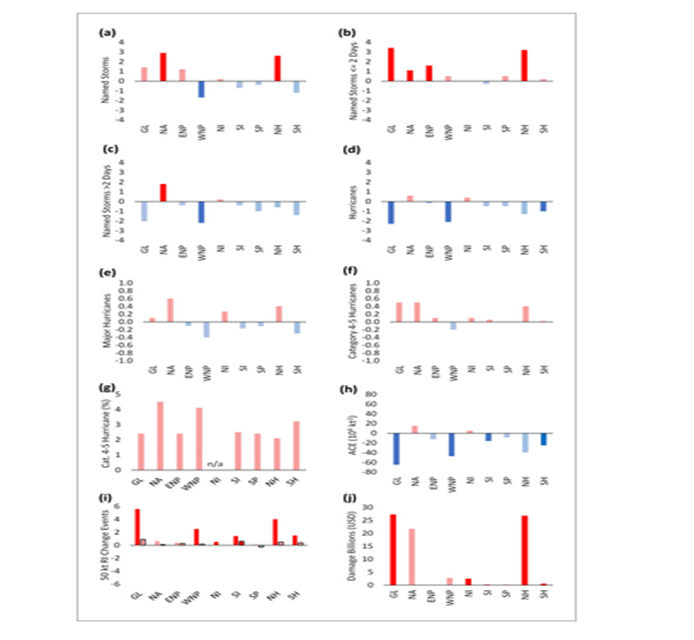
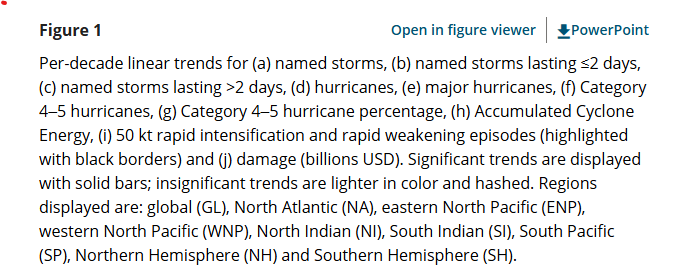
The cyclone news is even better for Fiji and other nations in the South Pacific. Data presented in multiple studies, for example, one study published in Geophysical Research Letters (GRL) in 2022 and a second published in Nature in 2023, show substantial declines in tropical cyclones in the Southern Hemisphere after accounting for decades of records. The Nature study ran available data through climate models and found hurricanes have declined sharply since 1900. The GRL study took a finer grain approach, breaking down cyclone data by basin. That study showed that tropical cyclone numbers in the South Pacific basin have declined slightly since 1990, with no change in the average yearly number of major storms. (See Figure 1, below)
To conclude, Adkins and Al Jazeera identify a number of threats to oyster production in Fiji, none of which have resulted in a decline in production so far. Rather than congratulating Fiji for its resilience and increasing success despite these threats, Adkins chose to lean into the “climate change causes everything bad” narrative and assert that climate change is causing worsening tropical storms, damaging Fiji’s oyster trade. This is false. Cyclones in the South Pacific basin have not become more frequent or powerful in recent decades and Fiji’s oyster production has increased. Shame on Al Jazeera for choosing to publish a scare-story based on falsehoods when the truth is easy to find. Perhaps Al Jazeera fact checkers took the day off or don’t know how to do their jobs well. Or perhaps the news outlet simply follows the old newsroom adage, “if it bleeds it leads,” and doesn’t find good news compelling.