









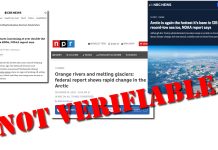

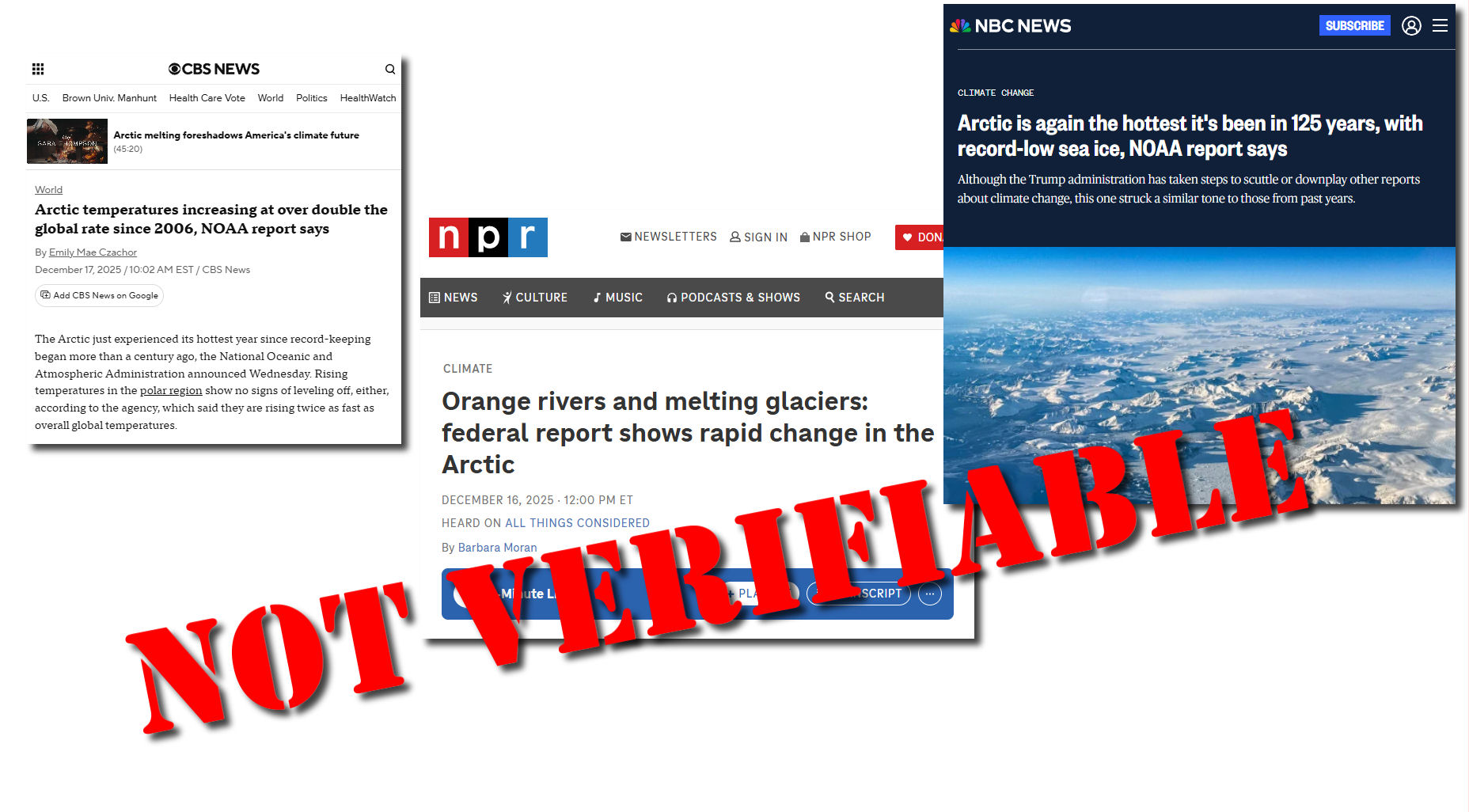
National Public Radio (NPR) recently published an article titled “Orange rivers and melting glaciers: federal report shows rapid change in the Arctic.” Simultaneously, CBS News published “Arctic temperatures increasing at over double the global rate since 2006, NOAA report says,” while NBC News published “Arctic is again the hottest it’s been in 125 years, with record-low sea ice, NOAA report says.” All three articles promote the claim that the Arctic is warming faster than the average rate of warming for the Earth as a whole, presenting this as clear evidence of accelerating human-caused climate change with far-reaching consequences. While the math may be technically true, based on history and the scarcity of long-term data, blaming the warming on climate change is unjustified. The period of data used is just 19 years, which doesn’t meet the 30-year criteria for a climate period. Further, all three articles ignore the lack of long-term weather data to compare the present short-term trend to.
The articles cite the National Atmospheric and Atmospheric Administration’s (NOAA) Arctic Report Card and lean heavily on the phrase “since 2006,” with CBS explicitly stating that Arctic temperatures have increased at more than double the global rate over that period, while NPR frames recent observations as proof of rapid, unprecedented change. But trends “since 2006” do not meet the most basic standard for defining climate. By long-standing convention, climate trends are evaluated over 30-year periods to filter out short-term variability. A roughly 19-year window on Arctic temperature is not a climate dataset; it is a snapshot. Presenting such a short interval as definitive evidence of long-term Arctic warming is a textbook example of confusing short-term patterns with durable trends.
NBC News claimed that the “Arctic is again the hottest it’s been in 125 years” but never mentions that historic temperature data for the entire Arctic region is relatively sparse and inconsistent over the past 125 years. Also, if the Arctic was as warm as now 125 years ago and more, human climate change couldn’t have been the cause and may not be the cause for the short-term warming trend the region is currently experiencing.
The problems with these kinds of reports are compounded by the Arctic’s uniquely sparse and inconsistent observational record. Reliable, continuous surface temperature measurements across much of the Arctic are relatively recent, with large areas lacking high-quality long-term data prior to the satellite era. As the Climate at a Glance analysis “Arctic Sea Ice” explains, the Arctic climate system is strongly influenced by natural variability, including ocean circulation patterns and atmospheric oscillations, which can drive multi-decadal warming and cooling phases independent of any long-term trend. Further, it notes that satellite data show summer minimum sea ice has not decreased at all since 2007, and has stabilized after a temporary low in 2012, seen in Figure 1 below.
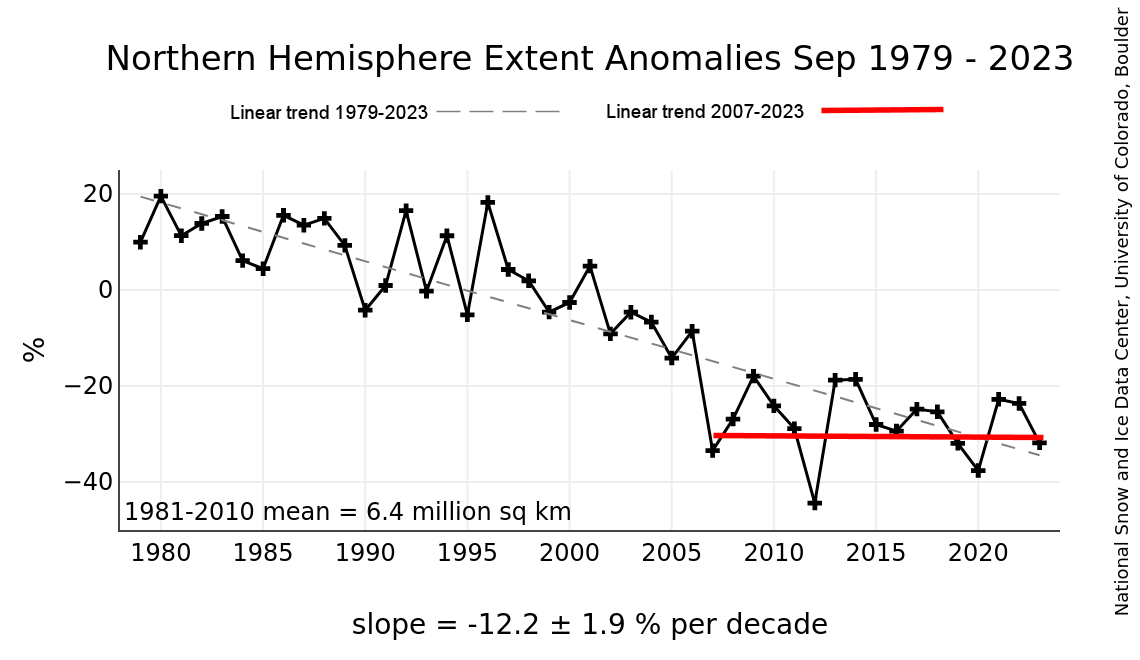
This is important because many claims pin other Arctic environmental changes on Arctic sea ice trends.
When you combine short records with a region known for large natural swings, it becomes impossible to say with confidence whether a post-2006 warming rate reflects a persistent climate signal or a temporary phase.
Climate at a Glance further notes that Arctic sea ice, glaciers, and temperatures have all exhibited substantial variability over historical and paleoclimate timescales, long before industrial-era CO₂ emissions. Periods such as the early twentieth century saw pronounced Arctic temperature increases comparable, in relative terms, to more recent decades. Without consistent, high-quality measurements extending well beyond the modern satellite era, claims of unprecedented warming rest on shaky ground.
The Intergovernmental Panel on Climate Change (IPCC) Sixth Assessment Report (AR6,) is far more cautious than the media coverage suggests. IPCC AR6 acknowledges Arctic warming as a feature in models and observations, but it also emphasizes uncertainties tied to data coverage, internal variability, and the relatively short observational record in polar regions. That nuance is missing from both NPR and CBS, which instead present recent conditions as if they settle the question.
Climate Realism has repeatedly addressed this issue, documenting how media outlets cherry-pick short timeframes to manufacture a sense of crisis. A simple review of Climate Realism’s Arctic coverage shows multiple examples where “fastest warming” or “record heat” claims collapse once longer records or broader context are considered. The pattern is familiar: select a recent starting point near a cool baseline, measure to a warm endpoint, and declare a dramatic trend—while ignoring earlier warm periods and the role of natural variability. In 2022, another “Arctic Report Card” media response was thoroughly debunked in CNBC and Other Media Outlets Miss the Mark Regarding NOAA’s Misleading ‘Arctic Report Card.’
In their recent scary reporting, NPR, CBS, and NBC all gloss over the fact that the Arctic is one of the most climatically dynamic regions on Earth. Sea ice extent, snow cover, and surface temperatures respond strongly to shifting winds, ocean heat transport, and cloud cover. These processes can amplify short-term warming just as easily as they can produce abrupt cooling. Treating such behavior as proof of a one-way, accelerating climate crisis oversimplifies a complex system.
By framing a sub-30-year slice of Arctic data as definitive evidence of a climate change induced crisis, without acknowledging the severe limitations of historical observations in the region, NPR, CBS, and NBC grossly mislead their audiences. The claim that the Arctic has been warming “at over double the global rate since 2006” may be mathematically true for that chosen interval, but it does not establish that a long-term climate driven warming trend exists. At best, it describes a short-term pattern whose significance remains uncertain.
This is not careful climate reporting; it is narrative-driven alarmism. Readers and viewers deserve to know that “since 2006” is not established as a climate change trend, that Arctic records are short and sparse, and that natural variability looms large in the far north, with proxy evidence suggesting the Arctic has been as warm with lower levels of ice coverage for extended periods multiple times. Without that critical context, these stories exaggerate certainty of a human cause and overstate what science can actually tell us about the Arctic.