









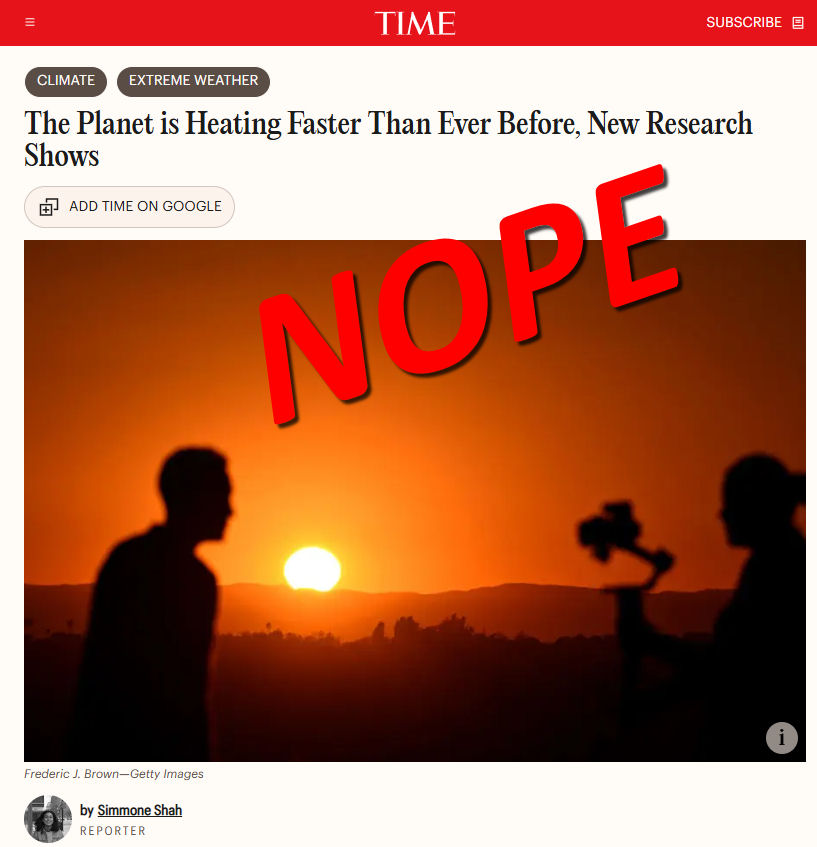
TIME Magazine claims in a recent article, “The Planet is Heating Faster Than Ever Before,” that global warming has dramatically accelerated since 2015. This is demonstrably false. Observational satellite data disagree with that claim, showing short-term variability driven by natural, short-lived events, with current temperatures now below the 2015–2016 El Niño peak. In addition, proxy data from the past also show many periods over which temperatures shifted much more rapidly and steeply, both upwards and downwards, than during the recent period of modest warming.
The TIME article cites research that claims warming has nearly doubled in pace since 2015, representing a sharp acceleration and warning the world could cross 1.5°C of warming within a few years. The claim rests on statistical adjustments that “filter out” natural variability such as El Niño and volcanic effects. That filtering is central to the narrative. The acceleration appears after removing natural influences from the temperature record that are clearly displayed in the raw data.
When we examine the observational satellite record, seen below, the story looks very different.
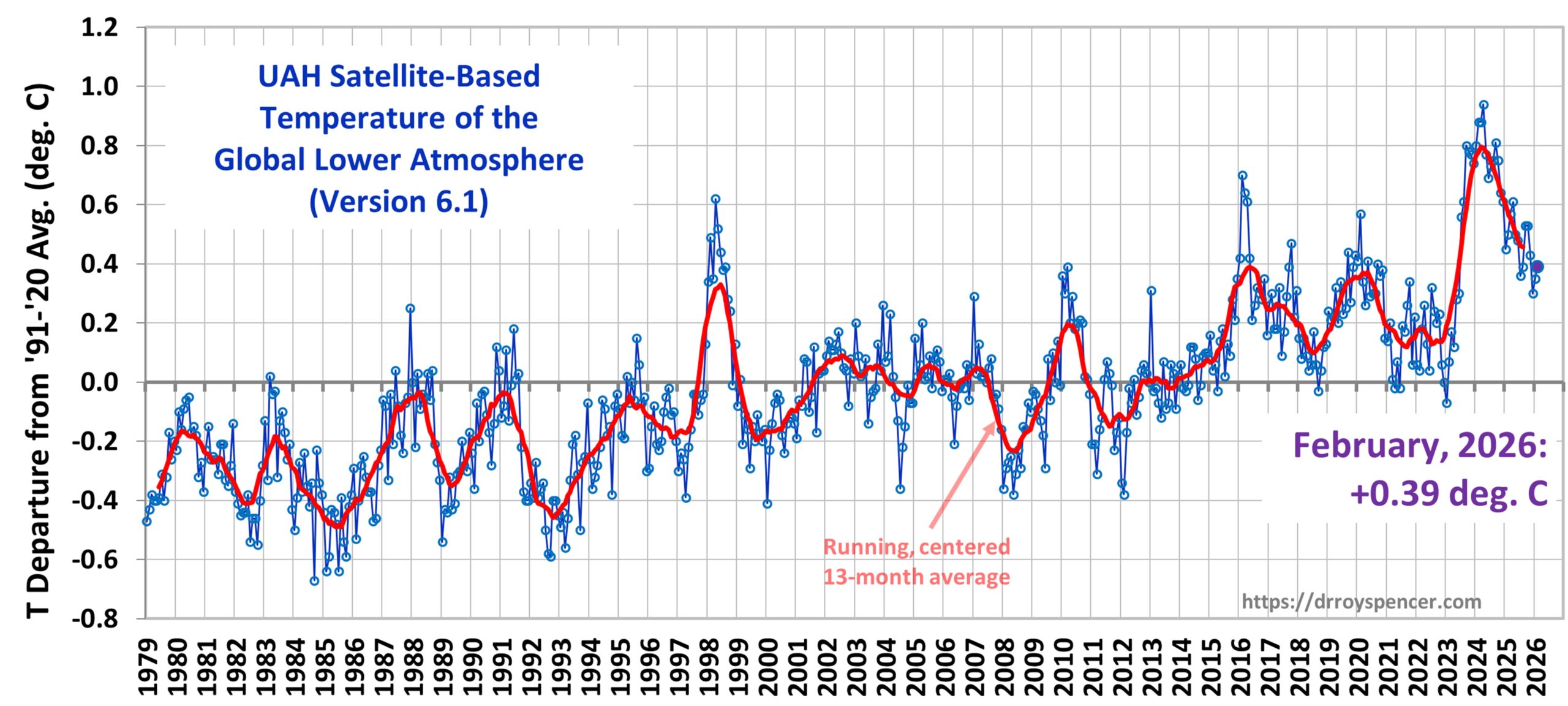
The University of Alabama in Huntsville (UAH) Version 6.1 global lower troposphere dataset show a long-term warming trend of +0.16°C per decade from January 1979 through February 2026. That trend has remained essentially stable for years. There is no visible post-2015 inflection point in the long-term slope.
The chart shows the strong 2015–2016 El Niño spike rising above +0.7°C relative to the 1991 to 2020 mean. After that peak, temperatures declined. The most recent value — +0.39°C in February 2026 — remains well below that earlier El Niño high-water mark in 2016.
If warming had truly “doubled” in rate beginning in 2015, today’s anomalies should sit well above the 2016 peak. But they do not.
It is also important to understand what caused some of the more recent spikes in the record. The unusually warm values in 2024 stand out in the UAH time series. But those occurred in the wake of the 2022 Hunga Tonga–Hunga Ha’apai volcanic eruption, which injected an unprecedented amount of water vapor into the stratosphere. That injection temporarily enhanced radiative forcing, aka the greenhouse effect, because water vapor is in fact the strongest greenhouse gas. It was a short-term perturbation — not evidence of a structural acceleration in the underlying greenhouse-driven trend.
The UAH report describes 2024 as “anomalously warm,” and the data show a return toward the longer-term trend through 2025 and into early 2026. That behavior — spike and partial retreat — is characteristic of natural variability superimposed on gradual warming.
TIME’s framing depends heavily on adjusted surface datasets where natural influences are mathematically removed. But climate is a long-term average of what actually happens in the real world, including El Niño events, volcanic eruptions, and short-term atmospheric changes. Removing those factors to produce a smoothed “underlying” curve does not demonstrate that the observable climate system has entered a new accelerated regime, though it does conveniently serve to advance the anthropogenic global warming narrative.
The long-term satellite trend remains modest and steady at +0.16°C per decade. That is not a doubling. It is not even a sharp upward trend; it is a continuation of a decades-long gradual increase punctuated by temporary spikes and dips.
Climate change is measured over decades, not from one El Niño peak to the next. When the full satellite record is considered — including the 2016 peak, the 2024 anomaly, and the current February 2026 value — the claim that the planet is heating “faster than ever before” since 2015 is not supported by the observational data.
Nor is it supported by paleo-climate proxy data that shows much more significant temperature shifts over short time periods multiple times throughout history, long before humans began emitting significant amounts of carbon dioxide into the atmosphere.
The first take away from this article is that TIME needs some basic fact checkers with an understanding of the English language. Data clearly demonstrate that the present warming is not “faster than ever before,” and certainly not larger. The UAH record shows gradual warming with natural variability layered on top. It does not show runaway acceleration. If TIME had bothered to look at actual data rather than uncritically regurgitating a press release, perhaps, if they were honest, it would have published a significantly different story – one with a far less alarming and patently inaccurate headline.