














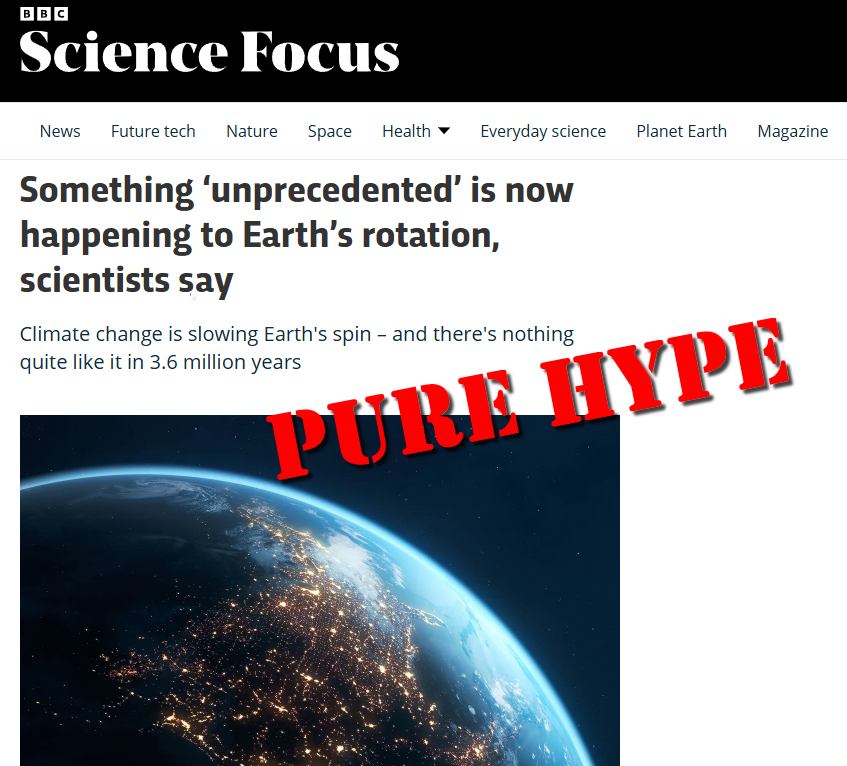
The British Broadcasting Corporation (BBC) Science Focus article “Something ‘unprecedented’ is now happening to Earth’s rotation, scientists say” claims that climate change is causing an “unprecedented” slowing of Earth’s rotation by 1.33 milliseconds per century, something not seen in 3.6 million years. This is false. The data show that millisecond-scale variations in Earth’s length of day are routine, naturally occurring, and both technologically and biologically insignificant.
The BBC sensationalizes the issue as something extraordinary, stating that today’s rate of change is “unequivocally” unlike anything in millions of years. But Earth’s rotation has never been constant. As explained in the Climate Realism rebuttal to Euronews on the same topic, seasonal atmospheric mass redistribution alone produces annual variations of 0.5 to 1 millisecond. Interannual ENSO shifts add another ±0.3 to 0.5 milliseconds. Decadal core-mantle coupling produces swings of 3 to 4 milliseconds. These are measured, observed phenomena, not model projections.
In that context, 1.33 milliseconds per century is not planetary destabilization. It is background noise, certainly nothing that would be noticed by even the most sensitive ecosystem or living being.
The BBC emphasizes that melting ice shifts mass toward the equator, comparing it to a spinning skater extending their arms. That physics analogy is correct in principle. What is incorrect is the implication that this is some new geophysical regime. Earth’s length of day has fluctuated throughout recorded history due to tidal friction from the Moon, atmospheric angular momentum exchange, ocean circulation, and core dynamics. The long-term tidal braking trend alone is about +1.7 to +1.8 milliseconds per century based on 2,500 years of eclipse records, a rate comparable to or larger than the BBC’s headline number.
Even more inconvenient for the narrative is the recent acceleration of Earth’s rotation. As noted in the Climate Realism piece, June 29, 2022 was the shortest day ever recorded in the atomic timekeeping era, about 1.59 milliseconds shorter than 86,400 seconds. If climate change were producing a simple, monotonic slowdown, we would not be seeing record-setting shorter days in the same decade.
The BBC also attempts to inflate the significance of the change by invoking dramatic metaphors. One researcher is quoted comparing the energy involved to a catastrophic earthquake, saying: “The change in the Earth’s rotational energy is equivalent to a magnitude 9.0 earthquake.” This is nothing but irresponsible doom mongering. The comparison is not about destructive force, as the article admits, but about abstract energy equivalence. It is an analogy designed to impress, not to inform. No cities are shaking. No ecosystems are collapsing. No lifeform on Earth can feel a thousandth of a second difference.
Let’s put the number in perspective. One millisecond is 0.001 seconds. A 1.33 millisecond change represents approximately 0.000015 percent of a 24-hour day. Human circadian rhythms are tuned to roughly 24 hours, not to thousandths of a second. There is no plausible biological mechanism by which such a tiny change could affect human health, animal behavior, or plant life. It is physiologically undetectable. Even if the rate of change were accurate, consistent, and sustained, it would take approximately 75,188 years for the day to lengthen by exactly one full second.
Technologically, the “crisis” BBC claims is even more absurd. Modern systems already handle irregular rotation through leap seconds. Since 1972, 27 leap seconds have been added to Coordinated Universal Time to synchronize atomic clocks with Earth’s spin. Discussions are underway about possibly implementing a negative leap second because of recent acceleration. GPS, spacecraft navigation, financial trading platforms, and astronomical observatories continuously ingest Earth orientation parameters from the International Earth Rotation and Reference Systems Service and adjust automatically. They already deal with corrections far larger than 1 millisecond.
Society adjusts clocks by one hour every year for daylight saving time in many regions. That is 3.6 million times larger than the 1.33 millisecond change being described. Leap years add a full day. Compared to those routine adjustments, this isn’t even a rounding error.
The BBC article goes further, suggesting that by 2100 climate change could outpace even the Moon’s gravitational influence on day length. That projection is model-dependent and scenario-driven. It assumes the now discredited and removed RCP8.5 high-emissions pathways and continued ice loss at rates embedded in climate models. It is not an observed reality. It is a modeled extrapolation.
And even if that projection were accurate, we are still talking about millisecond-scale shifts. The practical consequences remain limited to timekeeping adjustments that modern civilization already manages with ease. There is no crisis as the infinitesimal change in the Earth’s rotation has and can have no plausible impact on ecosystems or living beings.
Can you spot the millisecond shift in Earth’s rotation seen below?

Figure: DSCOVR EPIC – Earth Polychromatic Imaging Camera 20 images taken by the NASA probe showing the Earth spin at 23.4 degrees of tilt.
The most telling line in the BBC piece is the assertion that “human influence on the Earth system has become so profound that we are now changing the very way our Earth spins.” That statement is designed to provoke awe and alarm. It is also technically trivial. Humans also change Earth’s mass distribution through groundwater extraction, reservoir construction, mining, and urbanization. These processes are measurable, they are not existential.
In the end, the BBC’s hyped 1.33 millisecond per century change to the Earth’s length of rotation, even if true, represents trivial geophysical adjustment. One that is not biologically meaningful, technologically disruptive, and not outside the envelope of natural variability observed over decades and centuries.
Earth is not a precision quartz watch. It is a rotating, fluid planet with a molten core, dynamic oceans, shifting winds, and a gravitational partner in the Moon. Its spin rate fluctuates; it always has.
Framing a millisecond-scale variation as “unprecedented” planetary destabilization represents a a textbook example of taking a measurable but trivial geophysical adjustment and inflating it into a symbolic crisis. It is a giant nothingburger. An attempt to scare people with a story that is not scary in the least.