











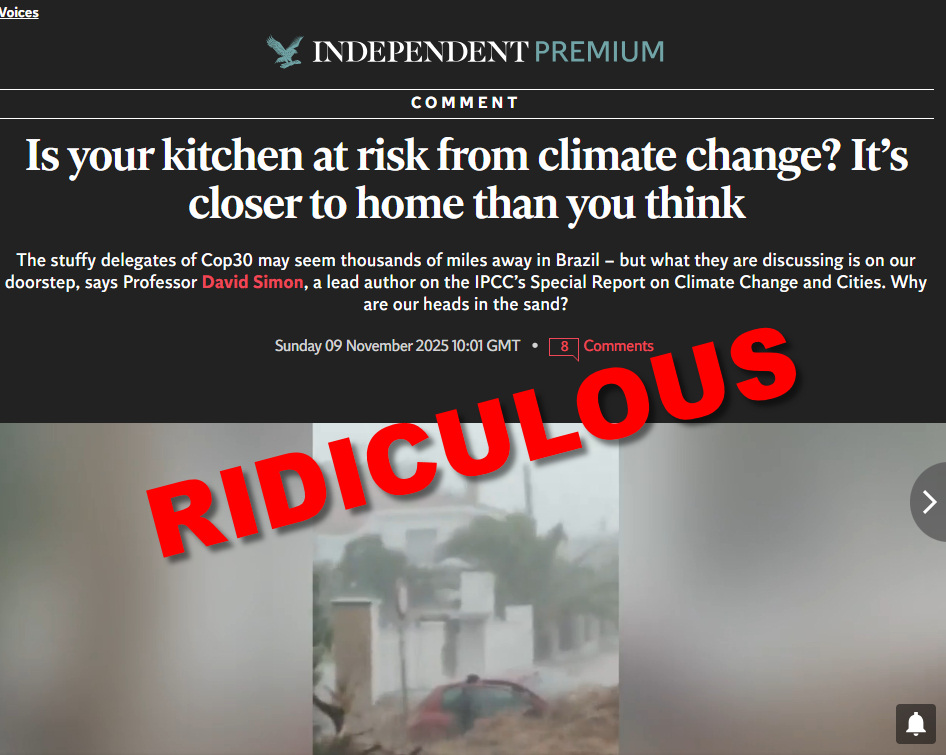
In The Independent’s article, “Is your kitchen at risk from climate change? It’s closer to home than you think,” author David Simon warns that the climate crisis has moved from “our children’s future” into our homes. Data show these claims are false. Weather hasn’t turned unusually severe nor is the U.K.’s continued survival threatened by flooding or sea level rise.
Simon claims that extreme weather is now threatening the “foundations on which we’ve built our lives,” pointing to recent floods, hurricanes, and NASA projections that supposedly show London and other urban areas will soon be under water, writing, “[i]ncreasing numbers of homes here and worldwide are being damaged or destroyed by flooding and other disasters.” He specifically references Hurricanes Katrina (2005) and Sandy (2012).
“The frequency of such flooding is increasing,” Simon asserts, concluding that ignoring or denying the “harsh realities of climate change . . . [is] short-sighted and delusional.”
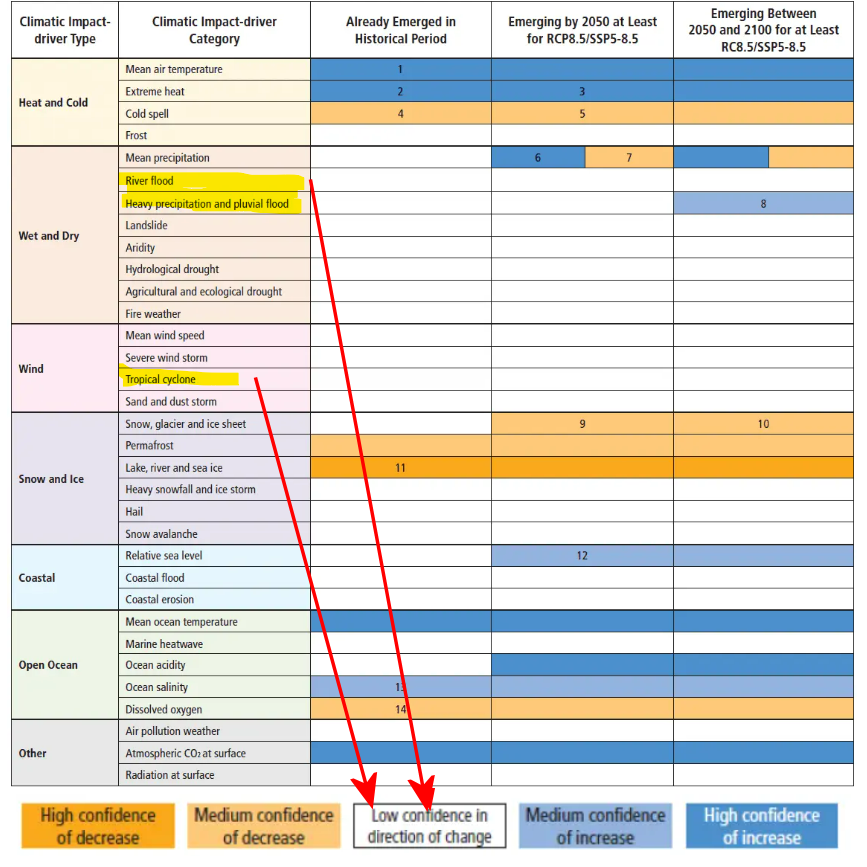
Simon’s commentary is long on rhetoric and unverified assertions, but short on facts. As Climate at a Glance: Hurricanes explains, long-term data on hurricanes show that there has been no increase in hurricanes as the planet has modestly warmed. In fact, data show hurricane numbers have trended slightly downward since 1971. Also, the U.N. Intergovernmental Panel on Climate Change’s (IPCC) Sixth Assessment Report—an organization Simon once contributed to—states plainly that there is “low confidence in any long-term trends in hurricane activity” and no detectable increase in global tropical cyclone frequency or landfall intensity. What’s true of hurricanes is equally true of flooding, the IPCC has discovered no worsening trend. See the IPCC table 12.12 below:
Attributing individual weather disasters to climate change is illegitimate. Floods and hurricanes are weather, not climate. They are temporary events shaped by local and regional atmospheric conditions, not global temperature averages. A flood in New York or a hurricane in the Caribbean does not prove a global trend—it’s a single data point in a noisy system. Only a long-term trend in flood or hurricane frequency or severity might suggest that climate change is making these types of events more common or more intense, but no such long-term trends exist.
When Simon cites the “unprecedentedly wet” period from 2022 to 2024 in the UK, he omits historical context. Britain’s Met Office records show comparable or worse flooding events going back centuries, including the devastating Thames 1947 flood. The event, considered one of the worst floods of the twentieth century, inundated thousands of acres of farmland, displaced tens of thousands of people, crippled business and industry, and caused major damage. Simon also missed the 1953 North Sea inundation “that struck low-lying coastal areas of the Netherlands, Belgium, and the United Kingdom. More than 2,000 people were killed on land and hundreds more at sea. It was the worst natural disaster of the 20th century in the United Kingdom and the worst in the Netherlands since the Middle Ages.” And these terrible natural disasters occurred when carbon dioxide concentrations in the atmosphere were much lower.
The idea that today’s storms are unique, worse, and driven by climate change is ridiculous.
Simon’s article also relies on speculative modeling rather than data. His warning that “NASA projections show vast swathes of [London] at severe risk of flooding by 2030” is based on computer-generated scenarios, not on actual measured trends. According to sea-level monitoring, the current rate of rise near London’s Thames Estuary at Sheerness is modest—around 1.5 millimeters per year—comparable to natural post-glacial rebound rates. London sits, on average, about 25 meters above sea level. At the Thames, the river bank varies from 1.5 meters above sea level at its lowest point to 21.6 meters at the highest level. As a result, at current rates of rise, it would take 1,000 to about 47,333 years for London to flood at the Thames shore depending upon the location. Thus, contrary to Simon’s alarmist claim, there is no sign of a “climate emergency” in the tide gauge record.
The broader scientific evidence aligns with Climate Realism’s repeated findings: floods, droughts, and storms show no consistent global increase. Localized urban flooding is often a function of poor drainage design, aging infrastructure, or land-use changes—not rising CO₂ levels. Moreover, IPCC acknowledges that climate change is as likely to have reduced flooding as it is to have made flooding events more common.
Which brings us back to the absurd headline question: “Is your kitchen at risk from climate change?” No, it isn’t. Your kitchen may be threatened by local planning mistakes, overdevelopment, and infrastructure failures, but it is not at risk from climate change. Climate change did not pour concrete over natural floodplains or build cities below sea level, humans did.
By conflating everyday weather with global climate, Simon and The Independent mislead readers into believing the ordinary is catastrophic. As Climate at a Glance: Extreme Weather points out, the media’s fixation on fear has no statistical foundation. The long-term record shows no significant global trend in extreme weather events. If there is any real risk highlighted by this story, it is of a possible erosion of public trust in media that chooses once again to promote false alarms over accurate reporting.