












In the recent Media Matters piece “CBS’ leadership in broadcast news climate coverage is chipping away under Bari Weiss,” the authors lament what they describe as a dramatic decline in climate coverage at CBS News. This shift is long overdue. CBS News appears to be recalibrating away from climate alarmism and toward more balanced editorial judgment.
For years, Media Matters celebrated CBS News as the leader in corporate broadcast climate coverage, noting that it aired more segments and more climate “solutions” content than its competitors. In 2025, CBS News accounted for 48 percent of total broadcast climate minutes. However, since Bari Weiss took over as editor-in-chief in October, the volume of climate stories declined sharply — just 20 minutes of climate coverage across seven segments through the end of the year as seen in the figure below.
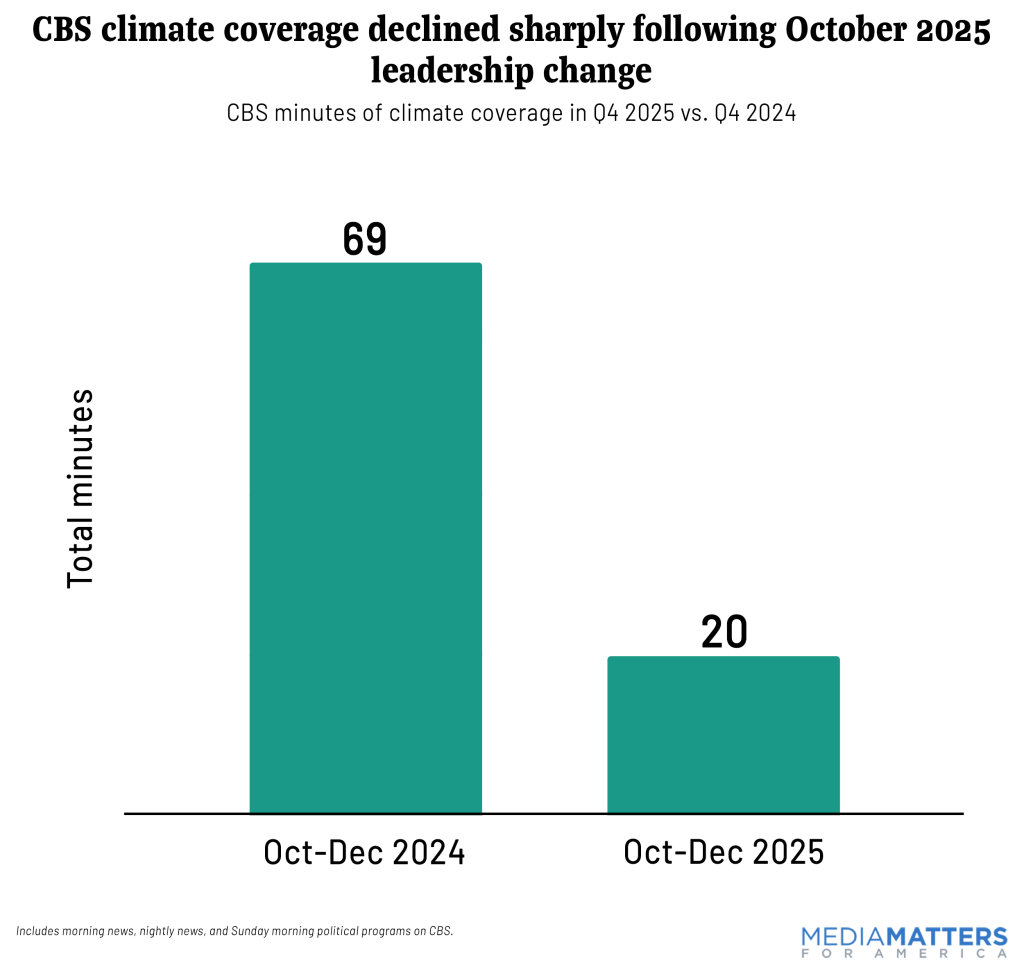
Media Matters frames the reduced coverage as a dangerous retreat from “science-based” reporting. But what the article documents is something else entirely, a return to balanced reporting and a grudging understanding that climate change is not the dire threat so often claimed by CBS in the past, and that other matters are more important to the media company’s audience.
Among Media Matters complaints was CBS coverage of a story in January discussing the fact that polar bear populations are expanding and the bears appear healthy despite sea ice decline. Media Matters treated that as an outlier story unworthy of airtime, but reporting positive ecological data when it exists is honest journalism. When evidence complicates a narrative, responsible newsrooms report it.
As meteorologist Ryan Maue, Ph.D. observed on X, “CBS News under Bari Weiss has completely ‘zeroed out’ climate alarmism on [the] network.” He added, “Only story in months was about polar bears being too fat.” That is not a network abandoning science. That is a network stepping back from saturation coverage that often blurred the line between reporting and advocacy.
Even more revealing is Media Matters’ concern that CBS News ended its partnership with the activist consortium Covering Climate Now. As Maue noted in a second X post, “CBS News ditched its cozy partnership with climate activist outfit Covering Climate Now, which controls content and coordinates narratives across media landscape.” That move suggests CBS is distancing itself from coordinated advocacy directed by outside interest groups and reasserting editorial independence.
The Media Matters article portrays Weiss’ leadership as importing “climate skeptics and contrarians” and reducing “institutional capacity” for climate reporting. But what it truly documents is a reduction in volume — not a demonstrated reduction in accuracy. Climate reporting does not become more rigorous simply by increasing minutes of airtime.
Quantity is not quality.
For years, broadcast networks often framed climate as a crisis requiring urgent political action, uncritically reporting unverified alarming climate claims as truth and frequently integrating policy advocacy language into reporting. Media Matters’ own praise for CBS’ past leadership underscores this: the network “devot[ed] greater attention to climate solutions.” “Solutions” coverage often meant amplifying regulatory proposals and emissions reduction campaigns.
A pullback from that approach does not leave a “void in the national climate information ecosystem,” as Media Matters claims. Rather, it is a return to honest journalism by putting the potential dangers of climate change in the proper context relative to other important, more immediate and pressing, public policy matters of greater concern to the public.
Climate change remains a legitimate topic for coverage, but it is not the only issue facing the country. While a majority of Americans polled express concern about climate change, it consistently ranks low as a top voting priority, often ranked at or near the bottom of national polls—sometimes 12th or lower. Editorial judgment involves prioritization. If CBS executives concluded that previous coverage levels were disproportionate or advocacy-leaning, adjusting course is not retreat. It is a well-considered recalibration.
Broadcast news should inform, not advocate.
Media Matters worries that fewer climate segments will leave voters “less prepared.” That incorrectly presumes that constant exposure to climate framing is inherently educational. Overexposure can produce fatigue, polarization, and declining trust — trends widely documented by the mainstream media.
By stepping back from coordinated activist partnerships and reducing overtly alarmist framing, CBS may be responding to audience skepticism about advocacy journalism.
While Media Matters is alarmed over the decline in hyperbolic reporting about climate change, savvy viewers may see this as a welcome return to journalistic independence and unbiased reporting. With the polls showing that trust in the media is at all-time lows, this shift, by restoring integrity to reporting, may also restore the public’s trust in media.
If CBS is choosing to prioritize balance over saturation, evidence over narrative coordination, and editorial autonomy over activist alignment, that is not something to lament. It is something to be applauded.