







Guest post by CERES Science.
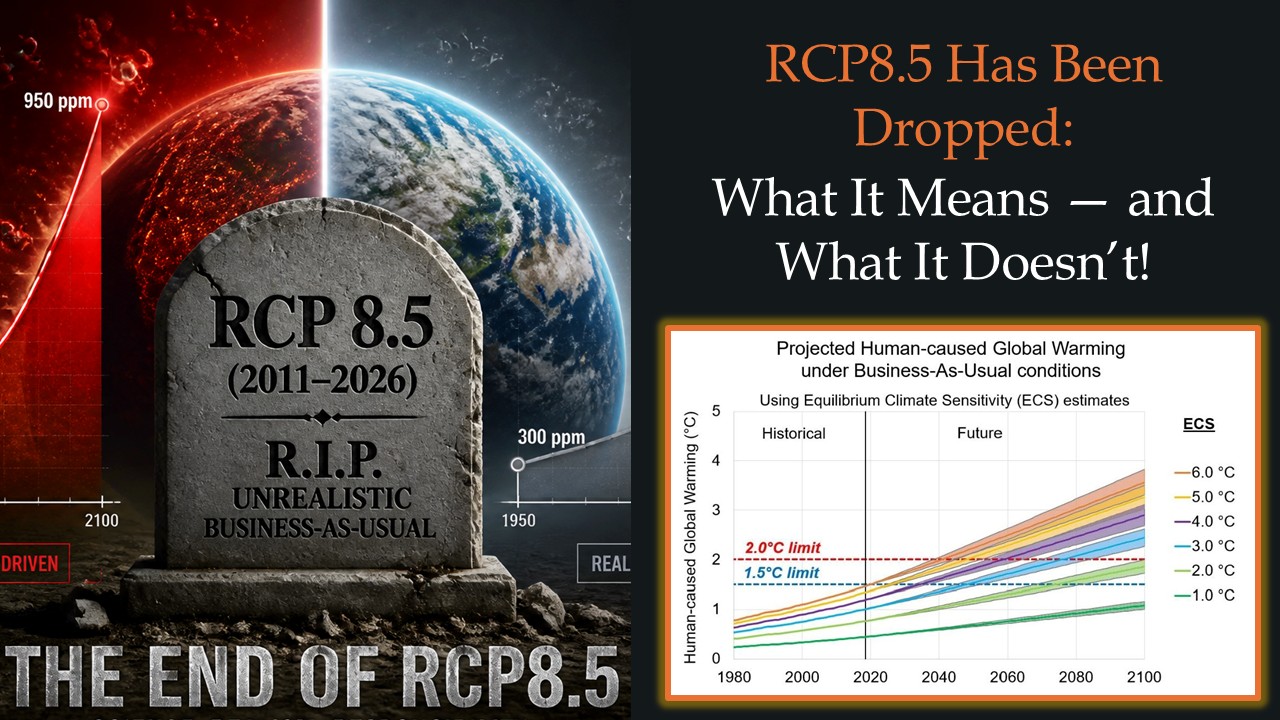
The developers of the greenhouse gas emissions scenarios for the IPCC’s next assessment report (AR7) have officially dropped RCP8.5 – the high-emissions pathway long treated as a de facto “business-as-usual” case (Van Vuuren et al. 2026).
We at CERES were among the first to criticize the use of RCP8.5 in the peer-reviewed literature (Connolly et al. 2020) and welcome this decision. But, while President Trump’s description of RCP8.5 as “WRONG! WRONG! WRONG!” has a kernel of truth beneath the hyperbole, the real story is more nuanced – less dramatic, but scientifically important.
Dropping RCP8.5 is a good step in the right direction. However, the IPCC still look to be set to continue their overreliance on computer model projections that are highly sensitive to changes in greenhouse gas concentrations. So, while their “business-as-usual” projections will probably be a bit less “hot” than before, unfortunately they still look set to be producing more “alarm-as-usual”.
In this essay, we discuss what RCP8.5 actually was, why it was problematic from the start, and what this change does – and does not – mean.
What exactly is RCP8.5 and why was it so significant?
According to current climate computer models, the main driver of past and future climate change is the concentration of “greenhouse gases” in the atmosphere.
Most of these greenhouse gases are naturally-occurring. However, many key human activities (energy usage, agriculture, etc.) also are associated with greenhouse gas emissions. For this reason, the UN and others – especially the computer modellers – have been insisting for decades that humans should be causing “anthropogenic global warming” (AGW) from our greenhouse gas emissions. [“anthropogenic” = is a more ‘sciencey’-sounding word for human-caused].
In fact, as Dr. Roger Pielke Jr. pointed out in a key 2005 paper (R. A. Pielke 2005), through their “Framework Convention on Climate Change” (UN FCCC), the UN has – at each of their annual UN Conference of the Parties (COP) meetings – been effectively defining all “climate change” as human-caused by definition for more than 30 years. These COP meetings are the annual UN gatherings where politicians and NGOs gather from around the world in a chosen city to discuss climate change policies.
This brings us to the so-called RCP scenarios – “Representative Concentration Pathways” (Meinshausen et al. 2011). For the IPCC’s 5th Assessment Report, the computer modellers had been given a choice of 4 different “projections” for what greenhouse gas emissions (and concentrations) might be over the coming centuries. Each scenario was given a number which represented the theoretical extra “radiative forcing” that greenhouse effect models said the extra greenhouse gases would have by the end of the 21st century – in units of Watts per square meter: 8.5, 6.0, 4.5 or 2.6.
In section 5.3 of Connolly et al. (2020), we discuss what scientific merit these theoretical “radiative forcing” calculations have for understanding the climate. But, within the climate modelling community, the size of this final theoretical value is the primary determinant of how much “global warming” would occur. So, the various scenarios were named based on that number: RCP8.5, RCP6.0, RCP4.5 and RCP2.6.
When you looked in detail at the emissions scenarios, RCP6.0, RCP4.5 and RCP2.6 all implied that there were major policy interventions to reduce greenhouse gas emissions during the 21st century. In contrast, RCP8.5 was the only scenario that didn’t assume major interventions.
Perhaps for this reason, the climate modellers began relying on the RCP8.5 scenario as the “business-as-usual” scenario. This meant that thousands of papers describing simulations of “the climate changes that will happen if we don’t do something urgently” ended up being published based on this RCP8.5 scenario – i.e., the one that has now been dropped.
Why was RCP8.5 unrealistic from the beginning and why has it been officially dropped?
When we wrote our paper in 2020, we noted that a few others had criticised the use of RCP8.5 as “BAU”. Ritchie and Dowlatabadi (2017b, 2017a) dug into the economics of the scenario and discovered the RCP8.5 assumed that societies would dramatically increase the use of coal over the next century – so much so that the scenario suggested that coal usage would burn more than 5 times the known reserves of coal!
They warned that this was ludicrous – but since they were writing in academic journals, the exact language they used was a lot milder:
“Accounting for this bias indicates RCP8.5 and other ‘business-as-usual scenarios’ consistent with high CO2 forcing from vast future coal combustion are exceptionally unlikely.” (Ritchie and Dowlatabadi 2017b).
Prof. Ritchie was joined in his criticism by others, including Prof. Pielke Jr. (who we met earlier), e.g., (R. A. Jr. Pielke and Ritchie 2021; Burgess et al. 2020).
Meanwhile, the scenario was also criticised from a completely different angle: Hausfather and Peters (2020) argued that the scenario was unrealistic because they believed governments were transitioning to lower emissions policies. They therefore insisted that “business-as-usual” should consider the recent trends in policies to be “business-as-usual”.
Ultimately, the recent decision to drop RCP8.5 from the next report seems to have taken Hausfather & Peter’s arguments as their primary justification:
“the CMIP6 high emission levels (quantified by SSP5-8.5) have become implausible, based on trends in the costs of renewables, the emergence of climate policy and recent emission trends” – Van Vuuren et al. (2026)
Although, they did also cite Ritchie & Dowlatabadi’s criticisms as a key factor in their decision.
However, our criticism of RCP8.5 in Connolly et al. (2020) came from a different angle…
What was our goal in Connolly et al. (2020)?
After the 2015 COP meeting in Paris, France, a highly influential agreement was signed called the Paris Agreement. All of the nations agreed to,
“…holding the increase in the global average temperature to well below 2 °C above preindustrial levels and pursuing efforts to limit the temperature increase to 1.5 °C above preindustrial levels” – UN Paris Agreement (UNFCCC 2016)
Parsing this convoluted statement and what it means was the main theme of our Connolly et al. (2020) paper. Essentially, they seemed to be saying that governments around the world would have to collectively implement major policy changes to keep global warming “below 2 °C above preindustrial levels”. But what did that mean?
What policies did they need to implement? How much “global warming” would be expected without these policies? What did they mean by “pre-industrial levels” – there have been many warm and cold periods over the millennia – which one did they consider “pre-industrial”?
We realised that this widely-promoted “agreement” didn’t mean anything unless you had some sort of answer for those questions.
So, for Connolly et al. (2020), we decided to try and answer a fundamental question that the Paris Agreement needed answered before the agreement could mean anything other than waffle:
“How much human-caused global warming should we expect with Business-As-Usual (BAU) climate policies?”
If we don’t know the answer to that, then how could policymakers figure out what to do to meet their nebulous “goal”.
When we tried to answer that question, we realised that the answer actually depends on four sub-questions:
-
How much greenhouse gases will we emit if we continue current trends?
-
How much of those emissions will remain in the atmosphere?
-
How much of the warming already observed is caused by humans?
-
How strongly do greenhouse gases warm the planet?
In our paper – very long, but methodical and systematic – we went through each of these questions, step-by-step. For each step, we surveyed the scientific literature to identify the different perspectives out there, looked at the available data, considered the various assumptions that could be made. We then compiled a best-estimate of what we could expect if trends continued “business-as-usual”, i.e., based on current trends.
We warned however that this was a multi-disciplinary problem[…]
Read the rest at CERES Science, here.