













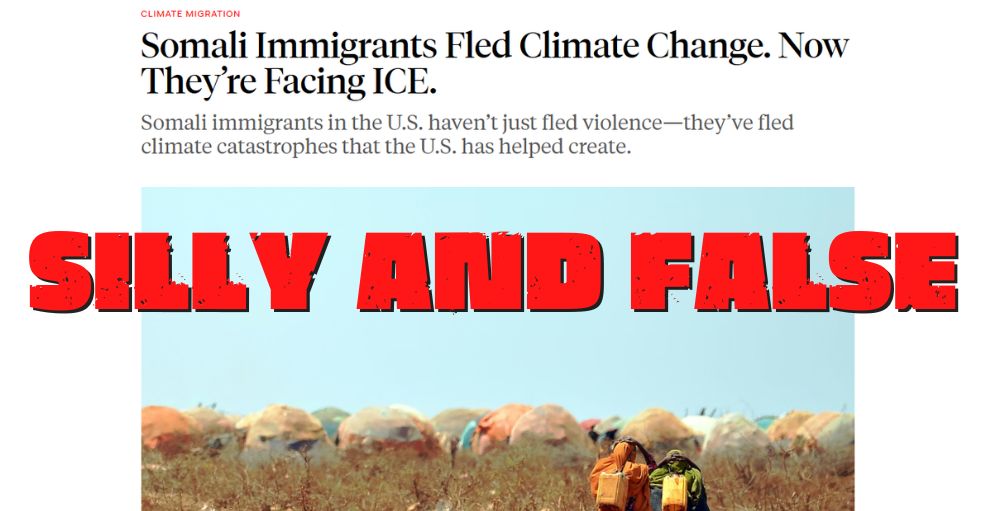
The New Republic (TNR) posted an article titled “Somali Immigrants Fled Climate Change. Now They’re Facing ICE,” claiming that Somali migrants in the United States have been driven out of their country by climate-change caused drought. This is false, or at least incomplete. Drought is a natural part of the region, even multi-year drought, and the present one is no different than the region has experienced with some regularity historically. It is civil strife and government corruption, resulting in continued poverty, that is leading Somalis to flee their homeland. With present governing institutions and security, they have been unable to improve water handling practices. Climate change has nothing to do with Somali emigration elsewhere in the region or to the United States, as even those interviewed for the article acknowledge.
TNR undermines its titular claim that unprecedented man-made climate change has forced Somalians to migrate by admitting that Somalian culture has “deep-rooted traditions of movement and migration.” TNR goes on to say that “Somalis have been caught in civil war and unrest for decades, and many have migrated to Kenya, Ethiopia, Europe, and the United States.”
Somehow not noticing the actual central point of that statement, that Somalians often move and that political strife has kept them destabilized, TNR says that climate change plays a “pervasive role” in the migration.
TNR claims that a multi-year drought “made a hundred times more likely due to warming caused by fossil fuel emissions—is affecting Somali people’s decisions to either relocate internally or migrate across international borders.”
Incredibly, later in the article, TNR refutes its own suggestion that this drought is worse, and pushing unprecedented migration, by explaining that this is how farmers have long dealt with drought in Somalia:
Traditionally, Somali pastoralists had resilient ways to deal with changes in rainfall and drought patterns, where families migrated and moved on a regular basis, even crossing borders in the process. But the nature of climatic changes—and conflict—overwhelmed their traditional capacities, leading to more rural-urban migration within the country and in East Africa.
That’s right, severe drought is something Somalians have dealt with for ages, long enough to have known traditions regarding adaptation to the dry periods.
There is no evidence that this drought is worse than those that drove historic migration.
The cited claim that recent drought in Somalia was made “a hundred times more likely” by climate change is not based on sound science. It comes from an attribution study from World Weather Attribution that specifically seeks to tie various weather conditions to human-caused climate change, they do not come to any other conclusions. Climate Realism has gone into the specifics of how unscientific World Weather Attribution studies are here, here, and here.
The TNR piece says that “[f]rom 2020 to 2023, the East Africa region had five failed rainy seasons, an unprecedented drought and climatic episode not seen in 40 years, which led to 70 percent crop loss, three million livestock deaths, and the displacement of about 2.9 million people in Somalia, according to some estimates.”
Admitting that a weather event also happened 40 years ago should tell a writer that their argument about something being “unprecedented” – meaning, without precedent, or never happened before—is faulty.
In fact, studies and data show a long history of swings between severe drought and monsoon floods in the region, and they show that nothing about modern drought is unprecedented. Paleo studies, including one published in Science, show that “intervals of severe drought lasting for periods ranging from decades to centuries are characteristic of the monsoon and are linked to natural variations in Atlantic temperatures.”
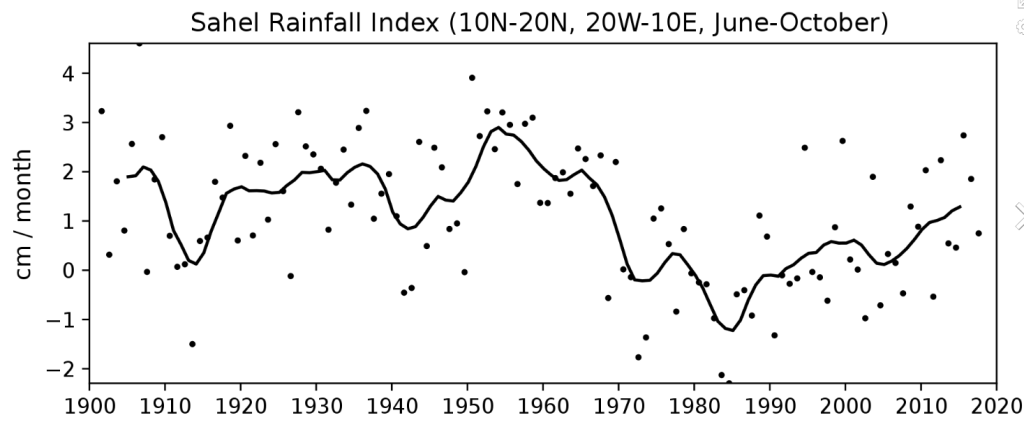
Climate Realism has covered this very claim before: In Anthony Watts’ “No, CBS News, Drought in Somalia is Not Being Driven by Climate Change,” he compared natural weather-driving patterns like the Atlantic Meridional Oscillation (AMO) and recent drought in Somalia and found repeated patterns of drought that were similarly severe.
Somalia is part of the Sahel region, and Watts shared this graphic of the region’s rainfall index since 1900, which shows that the rainfall in the Sahel varies widely over time:
Additionally, comparing crop production data between Somalia and neighboring countries like Ethiopia and Kenya reveals that even when drought impacts East Africa, Somalia is uniquely incapable of maintaining agricultural production. During the same period in which Ethiopia and Kenya saw increasing production in vital cereal crops, UN Food and Agriculture Organization (FAO) data show Somalia declining. (See figure below)
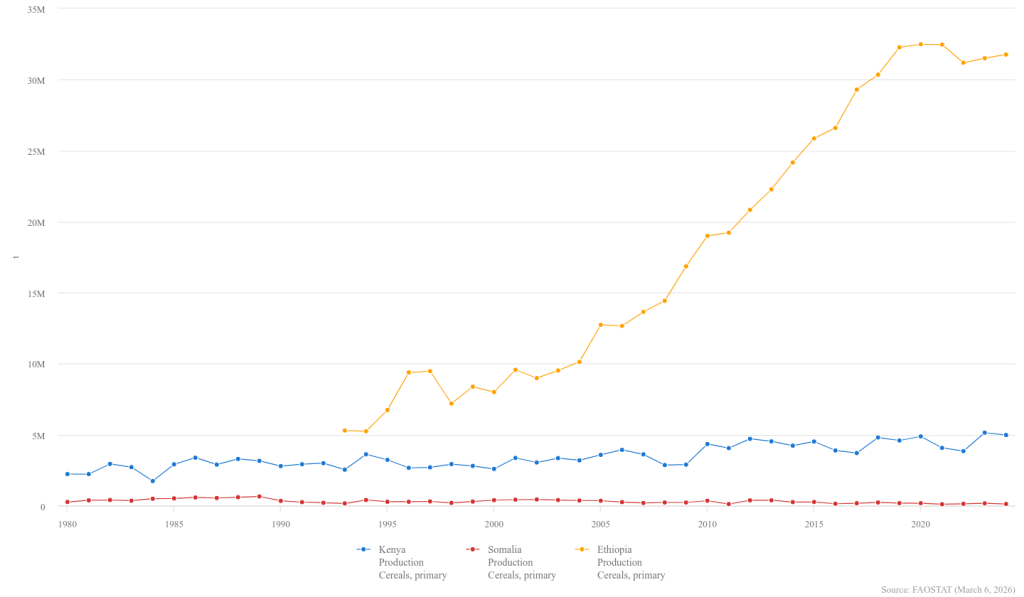
Is climate change not hitting Kenya and Ethiopia? What is the difference?
While Somalia has a long history of severe, recurring droughts, the worst drought in the past 50 years was the “Long-tailed Drought” from 1973 to 1975. That drought, and a subsequent similarly deadly drought in the early 1980s, occurred when the Earth was in a cooling spell and atmospheric carbon dioxide was much lower than today.
Somalia’s civil war and resulting destruction and corruption is the prime force behind Somalia’s emigration. Ironically, one of the interviewees in the TNR piece says as much:
Drought does not necessarily lead to famine and does not always lead to migration,” said Abdi Samatar, a Somali scholar and geographer at the University of Minnesota […] Somalis were unable to “put Humpty Dumpty back together in their country,” and in the absence of government support, “people have to do what they can for themselves,” Samatar added.
We at Climate Realism could not have said it better ourselves, though we have explained as much in past articles where mainstream outlets tried to link climate change and Somalia’s migration issue.
The New Republic’s effort to tie Somalians fleeing their country for the United States to climate change was a flawed, agenda-driven effort from the start. Even when those interviewed by TNR link the mass exodus of residents from Somali to other factors, TNR persists in pushing the narrative that climate change is playing a “pervasive role.”
It is true that Somalia is suffering through a severe, life threatening drought. It is also true that such droughts are not unprecedented but have been common throughout the region’s history. The nation’s unstable government and the ongoing, long-standing, civil war bear far more of the blame than climate change, especially since there is little or no evidence that Somalia’s climate has changed much over the past century.
The current drought is hitting Somalia’s populace worse than those of nearby countries in the region because of the political instability there. The New Republic was told this by the experts they interviewed but chose to ignore it to advance a climate scare story. Evidently, it’s too much to hope for honest journalism at The New Republic.